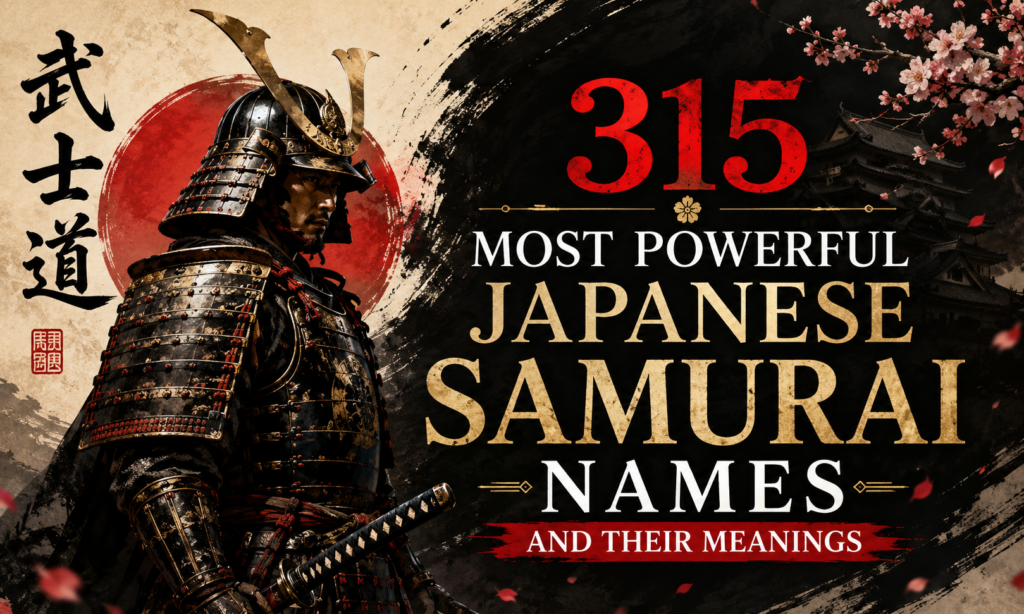
Samurai warriors were some of the most respected fighters in Japanese history. Their names carried deep meaning, strength, and honor. Each name told a story about who they were and what they stood for.
Japanese samurai names are more than just words — they reflect courage, loyalty, and power. Whether you are looking for a strong name for a character or just want to learn more, this list has something for everyone. Explore 315 of the most powerful samurai names and discover the meaning behind each one.
Japanese Samurai Names With Meaning
- Akira – bright and clear mind
- Takeshi – fierce and strong warrior
- Kenji – wise and peaceful second son
- Ryu – spirit of the dragon
- Hiroshi – generous and open hearted
- Kazuo – man of peace and harmony
- Noboru – one who rises above
- Isamu – brave and full of courage
- Yoshi – good luck and happiness
- Makoto – honest and sincere person
- Haruto – one who flies toward the sun
- Daichi – great wisdom of the earth
- Sora – open and free like the sky
- Kenta – healthy and strong in body
- Ryuji – second son of the dragon
- Satoru – one who understands deeply
- Naoki – honest tree that stands tall
- Fumio – one who values literature and learning
- Tadashi – loyal and morally upright person
- Minoru – one who bears good fruit
- Hayato – fast like a falcon
- Daisuke – great and helpful leader
- Katsu – one who always wins
- Shiro – fourth son, pure white soul
- Taro – firstborn son, great and strong
- Ichiro – first son with strong will
- Saburo – third born and reliable
- Jiro – second son who is diligent
- Kaito – ocean flying freely in the sky
- Ren – lotus, love, and connection
- Sho – one who soars and flies high
- Yuki – happiness and deep snow
- Hideo – excellent and outstanding man
- Masao – righteous and holy man
- Norio – man who follows the law
- Teruo – shining and glowing man
- Yoshio – righteous and happy man
- Kunio – man belonging to the country
- Tamotsu – protector and keeper of peace
- Susumu – one who keeps moving forward
- Osamu – disciplined and studious warrior
- Kiyoshi – pure and clean hearted
- Tsuyoshi – strong and firm in spirit
- Akio – bright and glorious man
- Shigeru – lush and thriving like nature
Japanese Samurai Names Female
- Tomoe – a blessed and beautiful warrior woman
- Yamabuki – mountain rose, gentle but strong
- Chiyome – a thousand generations of wisdom
- Tsuruhime – princess of the crane
- Nakano – woman of the middle field
- Hana – flower that never gives up
- Masako – elegant and righteous woman
- Kiku – chrysanthemum, symbol of long life
- Sayo – born in the small hours of night
- Rei – gratitude and beautiful spirit
- Fumiko – child full of literature and beauty
- Haruka – distant and free like spring
- Akemi – bright and beautiful at dawn
- Natsuko – child of summer warmth
- Yoshiko – good and righteous child
- Kazuko – child of peace and harmony
- Noriko – law abiding and gentle child
- Sachiko – child filled with happiness
- Teruko – shining and radiant child
- Sumiko – child of clarity and beauty
- Kimiko – noble and precious child
- Michiko – child of the beautiful path
- Yuriko – lily child, graceful and calm
- Hiroko – generous and open hearted child
- Shizuko – quiet and peaceful child
- Ayako – colorful and lively child
- Ryoko – child of the refreshing dragon
- Keiko – respectful and adored child
- Setsu – seasonal change and loyalty
- Taka – tall and honorable woman
- Asa – born in the morning light
- Fumi – one who values writing and wisdom
- Kane – doubly accomplished woman
- Matsu – pine tree, long lasting strength
- Michi – woman who walks the right path
- Mitsu – light and shining spirit
- Take – bamboo, flexible yet unbreakable
- Tomi – wealthy and blessed woman
- Toshi – mirror of wisdom and age
- Yae – eightfold strength and beauty
- Chiyo – one thousand years of strength
- Fuji – immortal and enduring like the mountain
- Hisa – long lasting and enduring woman
- Kiyo – pure and holy woman
- Natsu – born in summer, full of energy
Japanese Samurai Names Male
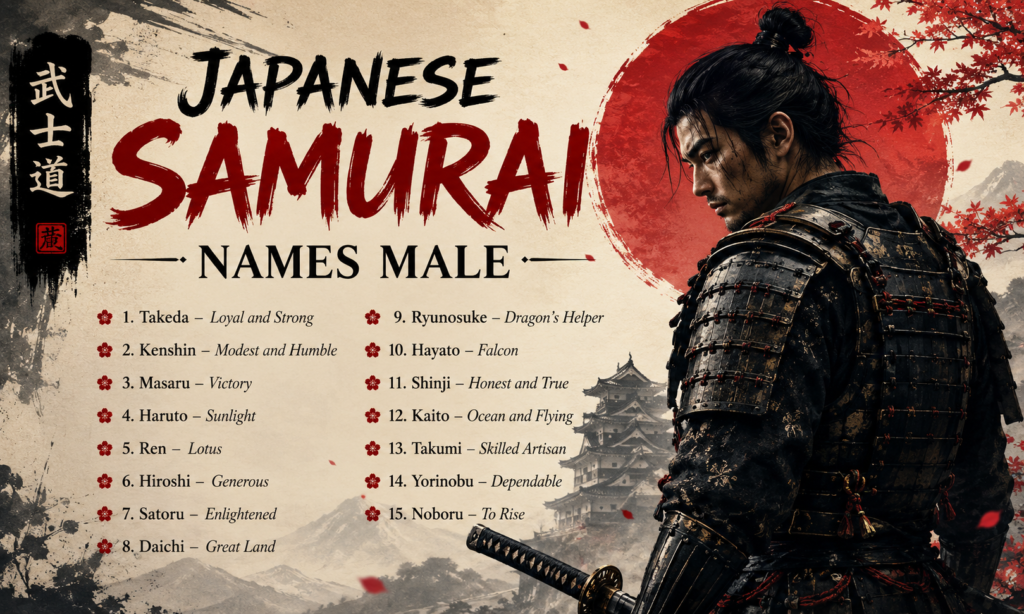
- Musashi – warrior of the floating bridge
- Masamune – righteous and true ruler
- Kenshin – heart of the sword
- Shingen – bold spirit of the faith
- Yukimura – village of happiness and snow
- Nobunaga – long reigning and prosperous leader
- Ieyasu – one who rests in peace and rules
- Yoshitsune – righteous and eternal warrior
- Benkei – strong guardian monk warrior
- Raiden – thunder and lightning spirit
- Genki – full of energy and good health
- Tenshi – heavenly and divine spirit
- Sanjuro – thirty year old wandering warrior
- Katsuro – son of victory
- Ryoma – dragon horse, wild and free
- Tesshu – iron and determined heart
- Hanzo – half of the war path
- Goro – fifth son, enduring and firm
- Shinzo – true and genuine heart
- Tetsuo – iron man of wisdom
- Kengo – strong and skilled swordsman
- Masaru – victorious and great warrior
- Taizo – great storehouse of strength
- Yoshimoto – good and righteous origin
- Ujiyasu – peaceful clan warrior
- Motonari – origin of great success
- Hideyoshi – excellent and prosperous warrior
- Mitsuhide – bright and shining loyalty
- Nagamasa – long and righteous leader
- Kiyomasa – pure and righteous leader
- Muneshige – source of strength in the clan
- Yoshihiro – wide spread goodness and loyalty
- Naomasa – honest and righteous leader
- Tadakatsu – loyal and victorious warrior
- Kanetsugu – golden virtue and succession
- Yukitaka – noble snow capped warrior
- Shigetsugu – continued growth and succession
- Nobutora – obedient tiger of the clan
- Harunobu – spring warrior full of faith
- Masatora – righteous tiger of power
- Ujinao – straight and honest clan leader
- Terumoto – shining origin of the clan
- Takakage – noble shadow of the hawk
- Motoharu – original spring and true source
- Tsunamoto – original source of endurance
Japanese Warrior Names
- Arashi – storm that cannot be stopped
- Kurogane – hard and unyielding black steel
- Raiju – thunder beast of the sky
- Tetsuya – iron night, enduring and dark
- Kamikaze – divine wind of great force
- Doshin – foot soldier with a calm mind
- Genpei – warrior spirit of two great clans
- Musha – armed warrior ready for battle
- Ronin – wandering warrior without a master
- Kenshi – one who fights with a sword
- Yojimbo – bodyguard who protects with honor
- Busho – military commander with sharp mind
- Ikusa – battle hardened and fearless fighter
- Bugeisha – one skilled in the art of war
- Heiwa – peaceful warrior who avoids conflict
- Tobi – one who leaps into the fight
- Hayashi – forest warrior, rooted and calm
- Yamato – great harmony of the Japanese spirit
- Kotaro – small but fast and fierce warrior
- Jotaro – pure and enduring warrior spirit
- Rentaro – lotus warrior full of connection
- Shotaro – rising and soaring warrior son
- Kintaro – golden boy warrior of legend
- Suikoden – warrior born of water and strength
- Gekido – warrior with a fierce and intense rage
- Fudo – immovable warrior rooted in earth
- Raiko – lightning warrior of the early dawn
- Yorimasa – righteous warrior of the clan roots
- Tametomo – faithful bow warrior of old Japan
- Yoshiie – house of the righteous bow warrior
- Shigemori – thriving forest of warrior strength
- Kagesue – shadow warrior who follows with honor
- Noritsune – law abiding and enduring warrior
- Kagekiyo – pure shadow warrior of the past
- Tomoe Gozen – brave woman warrior of the mist
- Masashige – righteous and thriving warrior spirit
- Kusunoki – camphor tree warrior who stands firm
- Nitta – new field warrior full of life
- Hatakeyama – flag mountain warrior of great fame
- Shiba –芝 grass field warrior, humble and strong
- Uesugi – above cedar warrior of high ground
- Takeda – warrior of the rice field and valor
- Imagawa – river warrior of the present moment
- Ashikaga – foot warrior of the reed river
- Shimazu – island warrior of the clear harbor
Samurai warriors were some of the most respected fighters in Japanese history. If you want to learn more about their real history, you can check out this complete list of samurai on Wikipedia.
Japanese Samurai First Names
- Akihiro – bright and widespread glory
- Yoshinori – righteous rule and good order
- Nobuyuki – faithful happiness and prosperity
- Katsuyori – victorious and trustworthy leader
- Harukata – firm and strong in spring
- Motoaki – bright origin of great potential
- Shigeaki – bright and thriving in all things
- Teruyuki – shining happiness for all
- Naohiro – honest and widespread goodness
- Yoshinobu – faithful to goodness and truth
- Hironobu – widespread faithfulness and trust
- Nobuhiro – widespread prosperity and trust
- Kazuhiro – widespread peace and harmony
- Masahiro – widespread righteousness and truth
- Norihiro – widespread rule and right order
- Toshihiro – widespread wisdom and reflection
- Yukihiro – widespread happiness of snow
- Akihiko – bright and shining prince
- Yoshihiko – righteous and good prince
- Nobuhiko – faithful and prosperous prince
- Kazuhiko – peaceful and harmonious prince
- Masahiko – righteous and excellent prince
- Norihiko – law abiding and upright prince
- Toshihiko – wise and reflective prince
- Yukihiko – happy and snow blessed prince
- Haruhiko – spring prince of bright days
- Fumihiko – literary and cultured prince
- Kunihiko – prince of the homeland and people
- Teruhiko – shining and radiant prince
- Shigehiko – thriving and growing prince
- Motohiko – original and true prince
- Kazunori – peaceful and rule following man
- Masanori – righteous and rule following man
- Yoshinori – good and rule following leader
- Tomonori – friend who follows the right rule
- Fumiaki – bright literary and scholarly man
- Noriaki – bright rule following warrior
- Shigeaki – bright and growing in all things
- Teruaki – bright and shining in glory
- Motoaki – bright origin of all things
- Haruaki – bright and open in spring
- Kuniaki – bright spirit of the homeland
- Tomoaki – bright and friendly spirit
- Hiroaki – widespread brightness and glory
- Nobuaki – faithful and bright in spirit
Japanese Samurai Last Names
- Yamamoto – one who lives at the mountain base
- Tanaka – one who lives in the rice field
- Watanabe – one who crosses the river
- Ito – one from the thread making family
- Suzuki – from the bell tree village
- Nakamura – from the middle of the village
- Kobayashi – from the small forest
- Saito – from the pure and holy well
- Kato – from the add wisteria family
- Yamada – one from the mountain rice field
- Hayashi – from the dense forest land
- Inoue – one who lives above the well
- Kimura – from the tree village roots
- Matsumoto – from the base of the pine tree
- Fujiwara – from the wisteria plain
- Minamoto – from the original water source
- Taira – from the flat and calm land
- Tokugawa – from the virtue river clan
- Oda – from the small rice field
- Shimazu – from the clear harbor island
- Mori – from the forest, rooted and calm
- Chosokabe – from the long and spear holding clan
- Otomo – from the great friend clan
- Ryuzoji – from the dragon elephant temple clan
- Hojo – from the north strip of land
- Sanada – from the true rice paddy field
- Kuroda – from the dark rice field roots
- Fukushima – from the blessed and fortunate island
- Honda – from the original rice paddy field
- Ii – from the good and righteous family
- Naito – from the inner wisteria clan
- Makino – from the open and wild field
- Ogasawara – from the small笠 sedge hat plain
- Hosokawa – from the narrow river valley
- Hatakeyama – from the flag field mountain
- Shiba – from the grass field family
- Toki – from the time and crane family
- Asakura – from the shallow storehouse clan
- Ouchi – from the great inner chamber clan
- Rokkaku – from the six corners clan
- Kitabatake – from the north warrior bamboo clan
- Nijo – from the second street of Kyoto
- Konoe – from the imperial guard family
- Ichijo – from the first street of Kyoto
- Tosa – from the high sandy shore clan
Gender Neutral Japanese Samurai Names
- Hikaru – one who shines and gives light
- Nao – honest and straightforward person
- Sora – free and open like the sky
- Haru – born in the spring season
- Natsu – full of summer warmth and life
- Aki – born in the bright autumn season
- Fuyu – calm and quiet like winter
- Ren – lotus, love, and strong bond
- Yuki – happiness or deep fallen snow
- Nori – one who follows the right way
- Tomo – a wise and caring friend
- Kazu – one who brings peace around them
- Nobu – faithful and full of trust
- Masa – righteous and correct in all things
- Yoshi – good and full of fortune
- Hide – excellent and outstanding in all ways
- Michi – one who walks the right path
- Fumi – one who loves writing and culture
- Toshi – one who reflects wisdom through age
- Shige – one who thrives and grows well
- Kimi – a noble and respected person
- Taka – tall, high, and full of honor
- Hiro – generous and widespread goodness
- Moto – the true and original source
- Kane – doubly talented and accomplished
- Kuni – one who belongs to the homeland
- Mitsu – light that shines in the dark
- Teru – one who glows and lights the way
- Take – strong and flexible like bamboo
- Matsu – enduring and long lasting like pine
- Asa – one born in the early morning
- Fuji – enduring and immortal like the mountain
- Hisa – long lasting strength and life
- Kiyo – pure and clean in heart and soul
- Setsu – faithful through every season change
- Masu – one who increases and grows always
- Tsuru – graceful and long living like the crane
- Kame – slow and steady like the turtle
- Tane – seed that grows into something great
- Ume – plum blossom, brave in cold weather
- Take – bamboo warrior, bending but never breaking
- Yomo – one who reads and knows all four directions
- Shino – slender bamboo, quiet and focused
- Kiri – mist that moves gently and freely
- Nami – wave that moves with calm powe
Conclusion
Japanese samurai names carry a weight that regular names simply do not. Each name on this list has a real meaning behind it, whether it stands for strength, loyalty, peace, or courage. These names were not picked randomly — they reflected the life and values of the person who carried them. That is what makes them so interesting to read and learn about.
Whether you are writing a story, naming a character, or just curious about Japanese culture, this list gives you plenty of good options to explore. If you are also interested in darker and mysterious names, check out our collection of Japanese names that mean death for more unique ideas.