Have you ever thought about giving your home a name? In Japan, naming a house is a long and beautiful tradition. Japanese house names carry deep meaning and reflect the spirit of the home. They are often inspired by nature, seasons, and spiritual beliefs. A good name can make your house feel truly special.
Japanese house names range from peaceful and poetic to ancient and powerful. Some names are connected to mountains, rivers, and cherry blossoms. Others carry spiritual meanings tied to harmony and protection. Whether you want something unique or traditional, there is a perfect name for every home. This list of 275 beautiful Japanese house names will help you find the one that speaks to your heart.
Unique Japanese House Names
These names stand out from the rest. Each one has its own personality and feel. They are simple but full of meaning.
- Kazehana – Wind flower
- Tsukimi – Moon viewing
- Harukaze – Spring breeze
- Midoriya – Green house
- Sorano – Of the sky
- Nijiya – Rainbow house
- Hotarubi – Firefly light
- Shirogane – Silver white
- Aozora – Blue sky
- Yukishiro – White snow
- Koganei – Little gold
- Taiyoko – Sun child
- Umibe – By the sea
- Hanazono – Flower garden
- Fujimi – View of Fuji
- Momijiya – Maple house
- Kasumiso – Misty nest
- Nagomiya – Calm house
- Irodori – Colorful
- Wakaba – Young leaf
- Shizukesa – Quietness
- Asayake – Morning glow
- Tanpopo – Dandelion
- Kuroyuri – Black lily
- Yoimachi – Evening wait
- Tokinoma – Timeless room
- Komoriya – Hidden house
- Akebono – Dawn
- Asagiri – Morning mist
- Namikaze – Wave wind
- Uguisu – Bush warbler
- Yamabiko – Mountain echo
- Kohakuya – Amber house
- Oboro – Hazy moon
- Shinraku – Simple joy
- Haruhi – Spring sun
- Fumoto – Foot of the mountain
- Tsutaya – Ivy house
- Shikisai – Four seasons color
- Izumiya – Spring water house
- Suzukaze – Cool breeze
- Shiranui – Unknown fire
- Tamagawa – Jewel river
- Kokoroya – Heart house
- Hoshimori – Star keeper
Japanese house names are deeply rooted in culture and history. You can learn more about Japanese naming traditions to understand how these names are formed and what they mean.
Japanese House Names in English
These names are Japanese in meaning but easy to understand in English. They work well if you want a name that everyone can read and remember.
- Sunrise Home – Hinode
- Quiet River House – Shizukawa
- Bamboo Rest – Takeyasumi
- Moonlit Path – Tsukimichi
- Pebble Garden – Ishiniwa
- Cedar Home – Sugiya
- Morning Light House – Asahiya
- Stone Bridge Cottage – Ishibashi
- Calm Waters Home – Nagisa
- Willow Rest – Yanagiyasumi
- Forest Edge House – Moriba
- Snowfall Cottage – Yukifuri
- River Mist Home – Kawagiri
- Soft Wind House – Soyokaze
- Cherry Blossom Rest – Sakurayasumi
- Old Pine Home – Furumatsuy
- Green Valley House – Aodani
- Raindrop Cottage – Amadare
- Twilight Home – Tasogare
- Lantern House – Toro
- Bluebell Rest – Kikyo
- Autumn Leaf Home – Koyo
- Firefly Cottage – Hotarugoya
- Sea Breeze House – Shiokaze
- Plum Blossom Home – Umeyashiki
- Cloud Peak Cottage – Kumotakane
- Gentle Rain House – Kosame
- Harbor Light Home – Minato
- Shadow Garden House – Kagebana
- Wooden Bridge Home – Kibashi
Japanese Mansion Names
These names are fit for a large and grand home. They carry a sense of history, power, and elegance without sounding over the top.
- Ryoanji – Dragon peace temple
- Shofuso – Pine breeze villa
- Kakurinso – Hidden forest villa
- Seifuso – Clear wind villa
- Tenshinso – Heavenly heart villa
- Meigetsuin – Bright moon hall
- Seiryuden – Blue dragon hall
- Hakurakuten – White joy hall
- Entsuji – Circle of grace hall
- Fukiageso – Rising wind villa
- Shunkaso – Spring flower villa
- Taigaso – Great river villa
- Kinkakuso – Golden pavilion villa
- Nanzenji – Southern zen hall
- Ryuguden – Dragon palace hall
- Shorakuen – Garden of small joy
- Gyokusendo – Jade spring hall
- Heirakukan – Peaceful hall
- Suikoen – Water light garden hall
- Umetei – Plum mansion
- Matsuotei – Pine tail mansion
- Kohakutei – Amber mansion
- Tsurugaoka – Crane hill mansion
- Hoshikawa – Star river estate
- Fujimansion – Wisteria great house
- Ryounkaku – Above the clouds hall
- Sekiuntei – Red cloud mansion
- Hakusuitei – Clear water mansion
- Rinshunkaku – Forest spring hall
- Seiunso – Blue cloud villa
- Shokintei – Pine lute mansion
- Kikugetsutei – Moon chrysanthemum mansion
- Reiunso – Sacred cloud villa
- Chishakuin – Wisdom hall
- Enshoji – Circle pine hall
- Fushimiya – Hidden water house
- Tatsumiya – Dragon water house
- Seiryu-so – Blue dragon rest
- Kasugatei – Spring day mansion
- Yumedono – Hall of dreams
- Garyuso – Resting dragon villa
- Shinkansen – New flow hall
- Hakuotei – White cherry mansion
- Karyobinga – Paradise bird hall
- Rinkaiso – Lakeside forest villa
If you love Japanese names, you might also enjoy reading about Japanese Names That Mean Moon For Girls & Boys for more beautiful name ideas.
Spiritual Japanese House Names
These names carry a peaceful and sacred feeling. They are connected to nature, the soul, and quiet living. Many families choose these names to bring good energy to their home.
- Anraku – Peaceful joy
- Myojo – Bright star
- Reika – Sacred flower
- Shinwa – Sacred harmony
- Tamagushi – Sacred offering
- Omamori – Protection charm
- Kamiya – House of the divine
- Enmusubi – Binding of fate
- Kotodama – Word spirit
- Misogi – Purification
- Shinto – Way of the gods
- Hakurei – White sacred spirit
- Kannagi – Serving the gods
- Chinkon – Calming the spirit
- Goshintai – Sacred body house
- Reido – Sacred earth path
- Mizuhame – Water goddess home
- Yamatsumi – Mountain god home
- Futodama – Great spirit home
- Izanami – Inviting spirit
- Takusen – Divine message
- Yorishiro – Spirit resting place
- Shinki – Divine energy
- Aramitama – Wild spirit
- Nigimitama – Gentle spirit
- Sakimitama – Blessed spirit
- Kushimitama – Wondrous spirit
- Harae – Purification home
- Tamamushi – Sacred beetle light
- Kamikaze – Divine wind
- Oharae – Great purification
- Shinsui – Sacred water
- Takamagahara – High heavenly plain
- Izumo – Land of clouds
- Amaterasu – Sun goddess home
- Tsukuyomi – Moon reader home
- Susanoo – Storm spirit
- Inari – Rice god home
- Raijin – Thunder god home
- Fujin – Wind god home
- Benzaiten – Goddess of water home
- Daikokuten – God of wealth home
- Bishamonten – God of war home
- Hotei – God of happiness home
- Ebisu – God of sea home
Ancient Japanese House Names
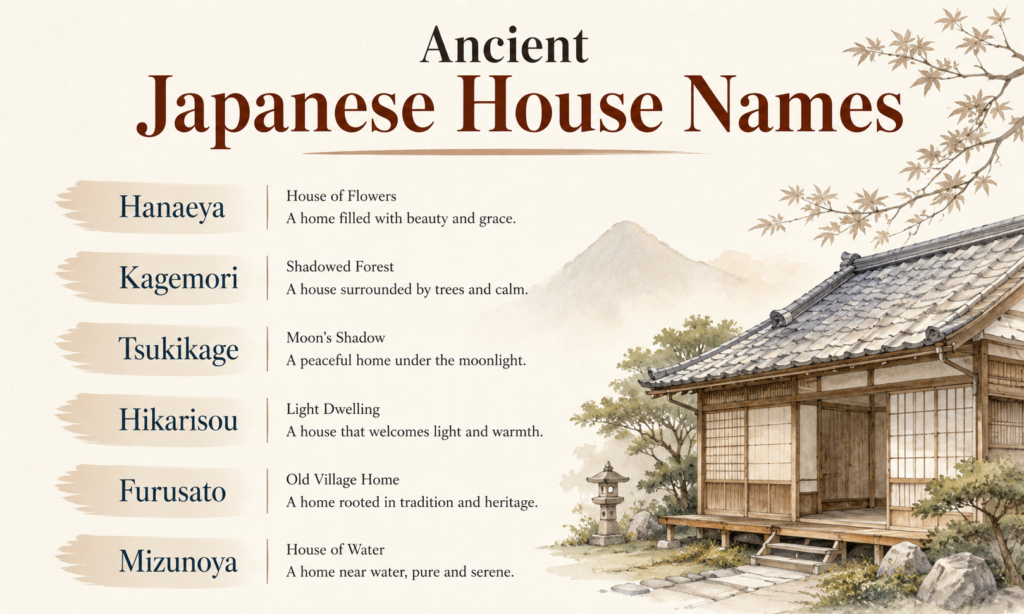
These names come from old Japan. They are tied to history, samurai culture, old villages, and ancient clans. If you love history, one of these might be right for your home.
- Yamashiro – Mountain castle
- Asuka – Flying bird
- Nara – Flatland
- Heian – Peace and calm
- Fujiwara – Wisteria plain
- Taira – Flatlands clan
- Minamoto – Source of water
- Ashikaga – Reed hill
- Tokugawa – Virtue river
- Oda – Small rice field
- Takeda – Bamboo rice field
- Uesugi – Upper cedar
- Mori – Forest
- Shimazu – Island harbor
- Chosokabe – Long arm part
- Otomo – Great companion
- Imagawa – Present river
- Hojo – North strip
- Asakura – Morning storehouse
- Hatakeyama – Farm mountain
- Rokkaku – Six corners
- Ouchi – Great inside
- Ryuzoji – Dragon elephant clan
- Sagara – Sand flat
- Satomi – Village of wisdom
- Yuki – Happiness tree
- Kitabatake – North bamboo growth
- Nanbu – South section
- Tsugaru – River passage
- Mogami – Highest upper river
- Gamo – Duck net
- Kuroda – Black rice field
- Ukita – Floating rice field
- Kobayakawa – Small quick river
- Kikkawa – Lucky river
- Murakami – Village above
- Sanada – True rice field
- Maeda – Front rice field
- Hosokawa – Narrow river
- Tsutsui – Bamboo well
- Niwa – Garden clan
- Sassa – Bamboo leaf
- Kanamori – Gold forest
- Inaba – Rice leaf
- Wakizaka – Young slope
- Fukushima – Blessed island
- Kato – Added wisteria
- Ikeda – Pond rice field
- Kurushima – Dark island
- Nishina – West field
- Ogasawara – Small bamboo plain
- Shoni – Small two
- Kikuchi – Chrysanthemum ground
- Otani – Great valley
- Amago – Rain child
- Rokkakuji – Six corners hall
- Yashiro – Field castle
- Kamakura – Sickle storehouse
- Yoshino – Good field
- Kumano – Bear field
- Izumi – Spring water
- Shirakawa – White river
- Kurama – Dark horse
- Kohata – Small flag
- Yamato – Great harmony
- Isonokami – Stone god
- Kofun – Old burial mound
- Tsurugi – Sword
- Hinomoto – Origin of fire
- Ohirume – Great sun lady
- Kashihara – Oak plain
- Mizugaki – Water fence
- Totsukawa – Far river
- Ikoma – Living horse
- Yoshiwara – Good plain
- Katsuura – Victory bay
- Fushimi – Hidden water view
- Toba – Bird wing
- Uji – Born of
- Shijonawate – Fourth rope crossing
- Negoro – Root black
- Nijo – Second street
- Sanjusangendo – Thirty three hall
- Byodoin – Equal hall
- Enryakuji –延暦 hall
- Kongobuji – Diamond peak hall
- Muroji – Village hall
- Horyuji – Flourishing law hall
- Yakushiji – Medicine master hall
- Toshodaiji – Great east hall
- Chuguji – Middle palace hall
- Shinyakushiji – New medicine hall
- Gangoji – Origin hall
- Kofukuji – Happy fortune hall
- Daigoji – Great purity hall
- Ninnaji – Benevolence hall
- Toji – East hall
- Saiji – West hall
- Saidaiji – Great west hall
- Todaiji – Great east hall
- Horyu – Flourishing dragon
- Asukaji – Flying bird hall
- Ikarugaji – Bird song hall
- Wakakusaji – Young grass hall
- Okadera – Hill temple home
- Tanzan – Cinnabar mountain
- Mimurotoji – Three room hall
- Ishiyamadera – Stone mountain hall
- Miidera – Three wells hall
- Shitenoji – Four heavenly kings hall
Conclusion
Finding the right Japanese house name is not as hard as it seems. This list of 275 beautiful Japanese house names gives you plenty of options to choose from. Whether you want something unique, spiritual, or ancient, there is a name here for every kind of home. A good house name adds meaning to the place where you live. It makes your home feel like more than just a building.
Japanese house names have been used for hundreds of years and they still feel fresh today. They carry stories, nature, history, and heart all in one word. Take your time and pick a name that feels right to you. Say it out loud and see how it sounds. When you find the one that fits, you will know it right away.