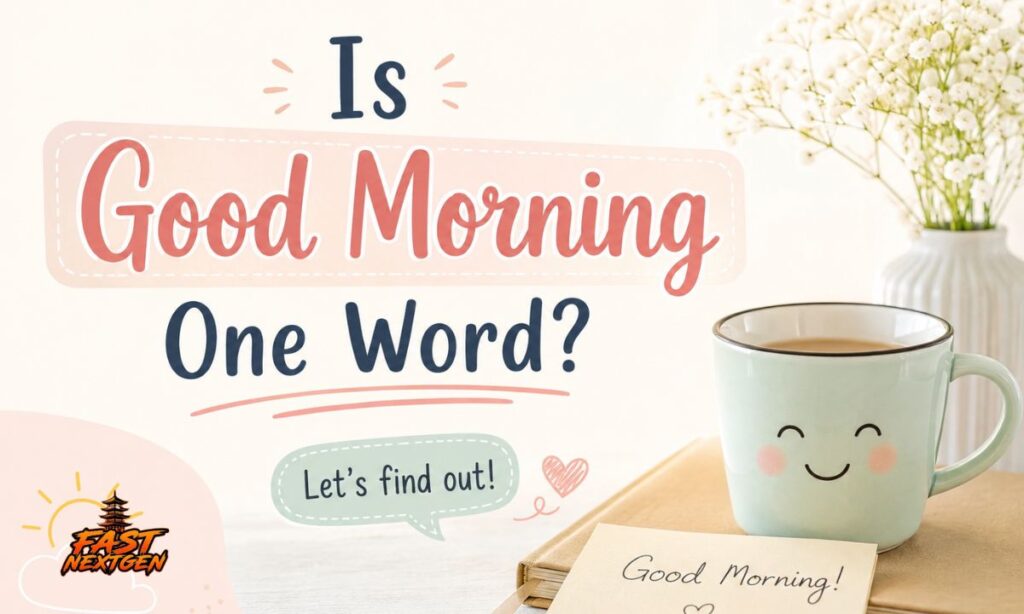
“Good morning” is two words — always. If you’ve been typing “goodmorning” as one word in your texts or emails, you’ve been making one of the most common spelling mistakes in English. Is good morning one word or two? The short answer is two, and it stays two words no matter where you use it: emails, texts, greeting cards, or spoken conversation.
I get why the confusion happens. We’re all used to “goodnight” being one word (or sometimes hyphenated as “good-night”), so it feels natural to assume “good morning” follows the same pattern. It doesn’t. Is good morning one word or two questions pop up constantly in grammar forums, ESL classrooms, and even professional writing groups — and the answer is consistent across every major English dictionary. In this guide, I’ll walk through exactly why “good morning” stays as two separate words, how “goodnight” broke the pattern, and how to use the phrase correctly in every context you’ll actually run into.
My Quick Answer
“Good morning” is always written as two words. There is no dictionary — Merriam-Webster, Cambridge, or Oxford — that lists “goodmorning” as a valid spelling. If you’re asking is good morning one word or two before sending an important email, the safe and correct choice is always two words with a space between them.
Why I Found It’s Written as Two Words
When I dug into how English greetings evolved, the pattern made a lot more sense. “Good morning” works as an adjective (“good”) modifying a noun (“morning”). That’s a basic grammatical structure, and English generally keeps adjective-noun pairs as separate words unless they’ve been fused together over long-term, widespread usage.
Words like “goodbye” merged over centuries — it actually started as a contraction of “God be with ye.” “Goodnight” followed a similar informal path in casual writing, though even that one is still technically two words in formal English (“good night”). “Good morning” never went through that fusion process. It has always functioned as a two-word phrase, and no major style guide or dictionary has changed that.
So when someone asks is good morning one word, the grammatical logic answers itself: it’s a standard adjective-plus-noun combination, and there’s no historical or linguistic reason for it to have merged into a single word.
The Basic Rule I Follow
Here’s the simple test I use whenever I’m unsure about greeting spelling:
- If the greeting names a specific time of day (morning, afternoon, evening), keep it as two words.
- If the greeting is a farewell or informal sign-off (goodbye, goodnight in casual use), it may be one word or hyphenated.
- When in doubt, check a dictionary — Merriam-Webster and Cambridge Dictionary both confirm “good morning” as two words, with no single-word entry at all.
This rule alone answers is good morning one word or two for almost every situation you’ll encounter.
The “Goodnight” Confusion: Why It’s Different
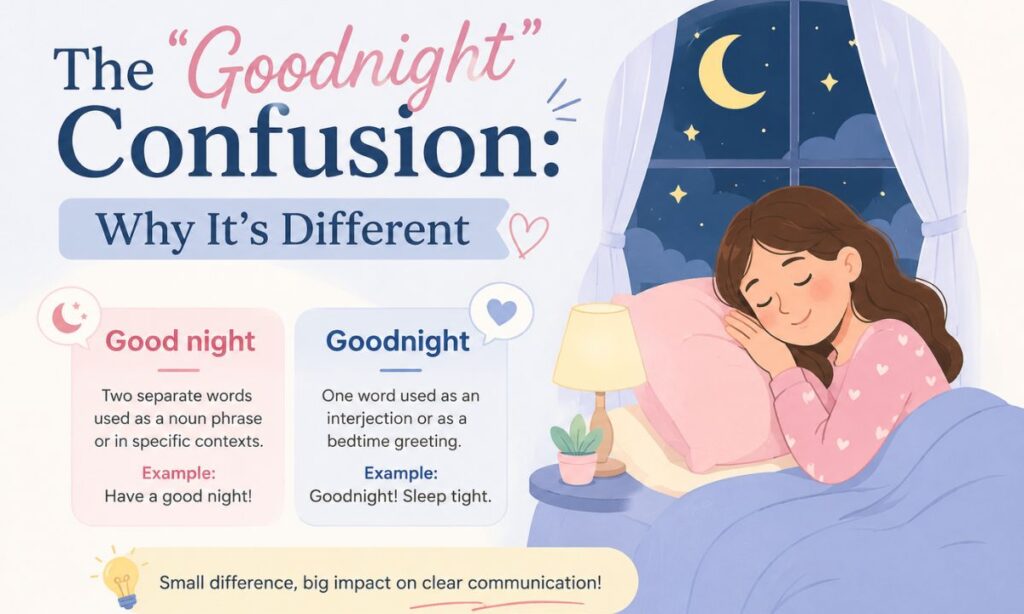
I think the “goodnight” comparison is the real source of the mix-up. People see “goodnight” written as one word so often — in texts, on greeting cards, in song lyrics — that they assume all time-of-day greetings follow suit. But “goodnight” earned its casual one-word form through decades of informal usage, especially in spoken English and pop culture.
“Good morning,” “good afternoon,” and “good evening” never went through that same shift. They’re still treated as standard two-word phrases in every dictionary and style guide I checked. So while “goodnight” gets a pass in casual writing, is good morning one word still has a firm answer: no, it’s two words, full stop.
Important Note I Found
Even “goodnight” isn’t universally accepted as one word in formal writing. Merriam-Webster lists “good night” (two words) as the primary form and “goodnight” as a less formal variant used mainly as an interjection or in casual contexts. That means the “safe” choice for formal writing is actually two words for both greetings — but “good morning” doesn’t even get the informal one-word option that “goodnight” has picked up.
When and How I Use “Good Morning” Correctly
Knowing that “good morning” is two words is step one. Knowing how to use it correctly in different settings is just as important, especially if you write professionally or communicate across formal and casual channels.
1. Email Greetings (Formal)
In professional emails, “Good morning” should be capitalized as a proper greeting, usually followed by a comma and the recipient’s name:
- “Good morning, Sarah,”
- “Good morning, team,”
This is one of the most common places people accidentally type “goodmorning” as one word, especially when typing quickly. Is good morning one word or two matters even more here because a misspelled greeting at the top of a formal email can look careless.
Also, read this : Take Effect or Take Affect
2. Casual Text Messages
Texting is more forgiving, but “good morning” still shouldn’t be squished into one word. You’ll often see it abbreviated instead:
- “Good morning! ☀️”
- “GM! Hope you slept well.”
Even in casual texts, keeping the two-word spelling (or using a recognized abbreviation like “GM”) looks more polished than “goodmorning.”
3. Verbal Greetings
When spoken aloud, “good morning” obviously doesn’t have a spelling issue — but the way people run the words together in speech is probably part of why the one-word spelling feels natural to some writers. Spoken fluency doesn’t change written grammar rules, though.
4. Cards and Notes
Handwritten notes and greeting cards almost always use the two-word form, often with extra styling like “Good Morning!” in bold or decorative lettering. This context reinforces just how standard the two-word spelling really is across formal and informal writing alike.
Common Mistakes I’ve Found and How to Avoid Them
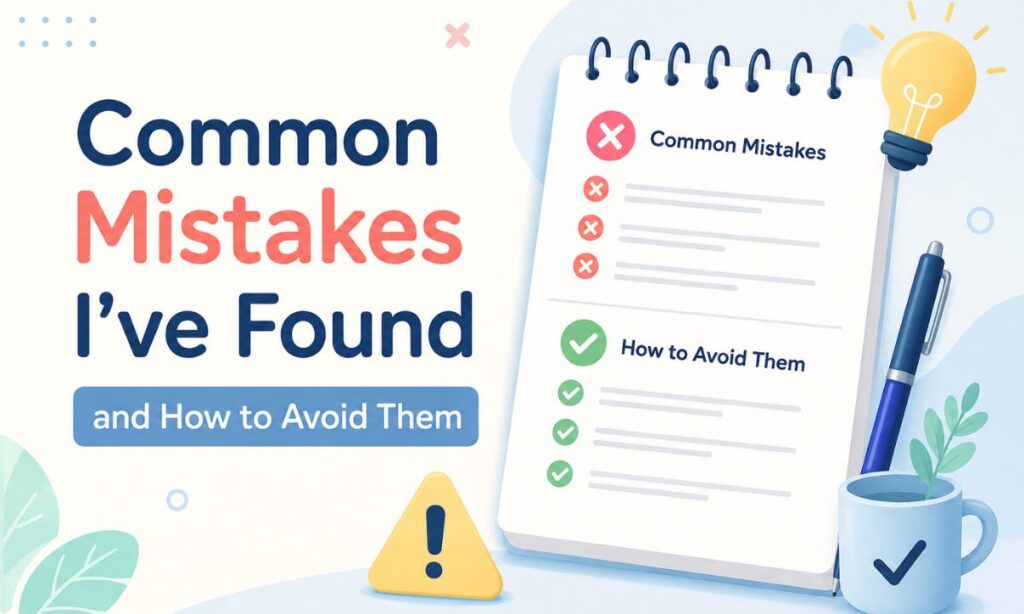
After reviewing how people misuse this phrase across emails, texts, and social captions, a few patterns show up again and again:
- Writing “goodmorning” as one solid word. This is the single most common error, especially in fast typing or texting.
- Skipping the comma before a name. “Good morning Sarah” should be “Good morning, Sarah.”
- Inconsistent capitalization. Mixing “good Morning” or “Good morning” randomly within the same document looks unpolished.
- Assuming the “goodnight” rule applies. As covered above, is good morning one word gets a different answer than goodnight because the two phrases evolved differently.
- Hyphenating it unnecessarily. Unlike some compound greetings, “good morning” doesn’t take a hyphen in standard English.
Avoiding these five mistakes covers almost every real-world scenario where the phrase trips people up.
Memory Tips I Use to Remember the Rule
If you still find yourself pausing to double-check is good morning one word or two, these two tricks make it stick.
Memory Trick #1: The “Wishing” Method
Think of “good morning” as short for “I wish you a good morning.” Since you’d never write “I wish you a goodmorning,” breaking the phrase back into its full sentence form makes the two-word spelling obvious every time.
Memory Trick #2: The Pattern Recognition
Compare it to “good afternoon” and “good evening” — nobody writes those as one word, and “good morning” follows the exact same pattern. If “goodafternoon” and “goodevening” look wrong to you (they should), then “goodmorning” is wrong too.
Other Greeting Patterns I Discovered
Looking at time-of-day greetings as a group makes the rule even clearer:
- Good morning — two words, always
- Good afternoon — two words, always
- Good evening — two words, always
- Good night — two words formally; “goodnight” accepted informally
- Goodbye — one word, fully merged over time
- Good day — two words, used mainly in formal or old-fashioned contexts
Notice that “good morning,” “good afternoon,” and “good evening” all behave identically. That consistency is a strong clue for anyone still asking is good morning one word — the entire time-of-day greeting family follows the two-word rule, with “goodnight” as the lone partial exception.
Real-World Examples I’ve Collected

Seeing the correct usage in context makes the rule easier to internalize than just reading definitions.
Email Example (Professional)
“Good morning, Mr. Alvarez,
I wanted to follow up on yesterday’s meeting and confirm our next steps.”
Text Message Example (Casual)
“Good morning! Coffee later? ☕”
Greeting Card Example
“Good Morning, Sunshine! Wishing you a bright and beautiful day ahead.”
In every example, the two-word spelling holds steady regardless of tone or formality — proof that is good morning one word or two has one consistent answer across contexts.
Good Morning vs Goodmorning: My Summary Table
| Feature | Good Morning (Correct) | Goodmorning (Incorrect) |
| Dictionary status | Listed in Merriam-Webster, Cambridge, Oxford | Not a recognized word |
| Word count | Two words | Incorrectly merged into one |
| Formal email use | Standard and expected | Looks like a typo |
| Casual texting | Acceptable and common | Still incorrect, though widely typed by mistake |
| Grammatical structure | Adjective + noun | Not a valid compound |
| Comparable greetings | Matches “good afternoon,” “good evening” | Doesn’t match any accepted pattern |
Pro Tip I Learned
If your keyboard’s autocorrect keeps flagging “goodmorning,” that’s not a glitch — it’s confirming the correct answer to is good morning one word or two. Trust the two-word spelling every time.
Explore More Grammar Guides
If this cleared up your confusion, you might also find these related grammar breakdowns useful: a guide to commonly confused word pairs in English, a deeper look at capitalization rules in greetings and salutations, and a breakdown of when to hyphenate compound words.
Conclusion
So, is good morning one word or two? It’s two words — consistently, across formal emails, casual texts, greeting cards, and everyday conversation. The confusion usually traces back to “goodnight,” which took a different, more informal path than “good morning” ever did. Once you remember that “good morning” behaves like “good afternoon” and “good evening” — never merging into a single word — the rule becomes second nature. Now you’ll never mix them up again.