
Do you write “shiney” or “shiny”? Most people pause here. It’s a small word. But it trips up a lot of writers.
Here’s the short version. Only one spelling is correct in standard English. The other one is a common mistake. In the Shiney vs Shiny debate, “shiny” wins every time.
This confusion isn’t random. English has a quiet little rule that explains exactly why. Once you see it, you’ll never second-guess yourself again. In this guide, we’ll break down the Shiney vs Shiny question from every angle — the rule behind it, the meaning, real-world examples, pronunciation, and the mistakes to avoid. By the end, “shiny” will feel automatic.
If you’ve typed “shiney” into a search bar just to double-check, you’re not alone. The Shiney vs Shiny mix-up is one of the most searched spelling questions in casual English writing. It shows up in product descriptions, school essays, social captions, and even resumes. That’s exactly why it’s worth settling once and for all.
My Quick Answer
“Shiny” is correct. “Shiney” is not a recognized word in standard English.
- ✅ Correct: shiny
- ❌ Incorrect: shiney
If you remember nothing else from this Shiney vs Shiny comparison, remember this: drop the silent “e” from “shine,” then add “y.” That’s it. That’s the whole rule. Every time the Shiney vs Shiny question comes up, this simple rule settles it.
Why I Found It’s Spelled “Shiny”
When I first looked into the Shiney vs Shiny question, I expected a complicated grammar explanation. There isn’t one. The answer comes down to a basic spelling pattern that English uses again and again.
The word “shiny” comes from the base word “shine.” To turn “shine” into an adjective, English speakers drop the silent “e” at the end and add “y.” That gives you “shiny,” not “shiney.”
Dictionaries like Merriam-Webster and Cambridge Dictionary list only one spelling: shiny. “Shiney” doesn’t appear as a standard headword in either. That alone settles most of the Shiney vs Shiny argument.
I’ve checked style guides, editorial handbooks, and even spellcheck databases while researching the Shiney vs Shiny topic. Every single one agrees. There’s no regional variant, no British-versus-American split, and no informal exception that makes “shiney” acceptable. It’s simply a misspelling, no matter where you learned English or which keyboard you’re typing on.
The “Drop the E and Add Y” Rule I Follow
This rule shows up all over English spelling, not just in this one word. Here’s how it works, step by step:
- Start with a word that ends in a silent “e” (like shine, bone, stone).
- Remove the silent “e.”
- Add “y” to the end.
- You get a new adjective (shiny, bony, stony).
Notice something? None of those words keep the “e” before the “y.” That’s the pattern. It’s consistent, and it’s the core reason “shiny” beats “shiney” in every dictionary and style guide.
Once you internalize this rule, the Shiney vs Shiny debate stops being confusing. You start applying the same logic to new words automatically, without needing to look them up every time.
My Definition and Meaning Analysis
Understanding the meaning helps lock in the correct spelling too. “Shiny” is an adjective that describes something that reflects light. It’s used constantly in daily writing, so getting the spelling right matters more than you’d think. Once the meaning clicks, the Shiney vs Shiny spelling question becomes much easier to remember, because you’re anchoring the word to a real, everyday concept instead of just memorizing letters.
Let’s break the definition into four practical categories.
1. Reflective Surfaces
A shiny surface bounces light back at you. Think of a mirror, a polished floor, or wet pavement under streetlights. This is the core, literal meaning of the word.
2. Clean and Polished
Something shiny often looks clean and well cared for. A shiny kitchen counter or a shiny pair of shoes signals effort and freshness.
3. Bright and Gleaming
This sense leans emotional and descriptive. Shiny eyes, a shiny smile — these phrases suggest brightness that feels alive, not just physically reflective.
4. Metallic Surfaces
Metal is where “shiny” shows up most often. Shiny chrome, shiny jewelry, shiny coins — the word pairs naturally with anything metallic. Even in casual conversation, “shiny” is the default word people reach for when describing anything metallic and light-catching.
Across all four senses, the spelling never changes. Whether you’re describing a shiny car or a shiny idea, it’s always “shiny,” never “shiney.” That consistency is part of why the Shiney vs Shiny question has such a clear, simple answer.
The Pattern: Similar Word Transformations
The Shiney vs Shiny rule isn’t a one-off. English applies this same silent-e-drop pattern to dozens of common words. Here are a few:
- Shine → Shiny
- Bone → Bony
- Stone → Stony
- Grime → Grimy
- Spice → Spicy
- Noise → Noisy
Look closely, and you’ll see none of these keep the “e” before adding “y.” That’s not a coincidence — it’s a spelling convention baked into English word formation.
This pattern is exactly why the Shiney vs Shiny mistake feels so tempting. Learners often assume every silent-e word keeps its “e” when a suffix is added. In reality, the opposite is true for this common word family.
Why This Pattern Makes Sense
English tends to simplify when adding suffixes to silent-e words. Keeping the “e” would create an awkward double-vowel sound (like “shiney” visually suggests a longer “ey” sound). Dropping it keeps the word clean and matches how it’s actually pronounced. This is also why so many learners misspell “shiny” as “shiney” — the extra “e” feels intuitive, even though it’s wrong.
Understanding this logic makes the Shiney vs Shiny rule stick far better than just memorizing it. You’re not just learning one word — you’re learning a pattern that applies across dozens of similar words in English.
Also, read this : Is Good Morning One Word
Shiney vs Shiney: My Visual Comparison
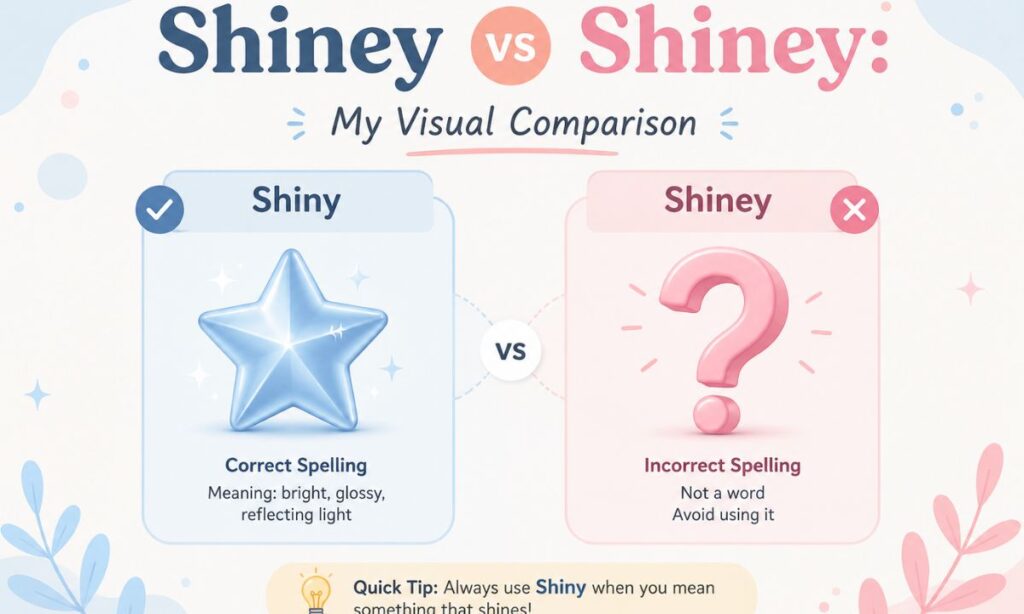
Here’s a side-by-side look to make the Shiney vs Shiny distinction crystal clear.
| Feature | Shiny (Correct) | Shiney (Incorrect) |
| Dictionary status | Listed in Merriam-Webster, Cambridge | Not a recognized word |
| Spelling rule followed | Drop silent e, add y | Breaks the rule |
| Common usage | Standard in all writing | Typo or common mistake |
| Formal writing | Acceptable | Not acceptable |
| Pronunciation | SHY-nee | Same sound, wrong spelling |
This table sums up the entire Shiney vs Shiny debate in one glance. One column is standard English. The other is a spelling error. Bookmark this comparison if you tend to forget which side of the Shiney vs Shiny divide is correct.
Real-World Examples I Use
Seeing the word in context helps the correct spelling stick. Here are examples across different settings, all using the correct side of the Shiney vs Shiny divide.
Daily Life Examples:
- The kitchen floor was shiny after mopping.
- Her shiny hair caught everyone’s attention.
- He drove a shiny new car to work.
Business and Professional Examples:
- The product packaging featured a shiny metallic finish.
- Our brand guide calls for a shiny, polished logo design.
- The showroom floor was shiny enough to see your reflection.
Creative and Descriptive Examples:
- The dragon’s scales were shiny like polished emeralds.
- Moonlight made the lake look shiny and silver.
- Her shiny eyes lit up when she saw the gift.
Examples of What NOT to Write:
- ❌ The floor was shiney after mopping.
- ❌ She has shiney hair.
- ❌ His shoes looked shiney and new.
Every one of those incorrect examples should use “shiny” instead. This is the most common mistake writers make in the Shiney vs Shiny comparison.
Pronunciation Guide I Use
Even though the spelling differs from what some expect, the pronunciation is simple and consistent.
Phonetic Pronunciation
“Shiny” is pronounced SHY-nee, with two syllables. The stress falls on the first syllable. It rhymes with words like “tiny” and “whiny.” This pronunciation stays the same regardless of how someone mistakenly spells it — which is exactly why the Shiney vs Shiny confusion happens so often. The word sounds like it could have an extra “e,” even though it doesn’t.
Shiney vs Shiney: My Summary Table
Here’s a quick reference you can bookmark.
| Question | Answer |
| Is “shiny” correct? | Yes, always |
| Is “shiney” correct? | No, never in standard English |
| What’s the rule? | Drop the silent e, add y |
| Base word? | Shine |
| Part of speech? | Adjective |
| Pronunciation? | SHY-nee |
Did You Know?
“Shiny” follows the exact same transformation pattern as “shine” becoming “shining” — both drop the silent “e” before adding a suffix. It’s one of the most predictable rules in English spelling, yet also one of the most commonly broken.
Common Mistakes I’ve Learned to Avoid

Even confident writers slip up on this one. Here are the three most frequent errors tied to the Shiney vs Shiny mix-up, along with quick fixes for each.
Mistake #1: Adding Unnecessary Letters
The biggest mistake is simply adding an extra “e” before the “y.” This usually happens because “shiney” looks like it should be correct, especially to ESL learners or fast typers.
Mistake #2: Confusing with Similar Words
Some writers confuse “shiny” with “shinny,” a different word entirely (meaning to climb using your hands and legs). They sound similar but mean completely different things.
Mistake #3: Inconsistent Spelling
Using “shiny” in one paragraph and “shiney” in another is a common issue in longer documents. Once you know the Shiney vs Shiny answer, stay consistent throughout your writing.
When to Use “Shiny” in Different Contexts
“Shiny” works across nearly every writing style, but tone can shift how it’s used.
Formal Writing
In business reports or academic writing, use “shiny” sparingly and precisely — for example, describing a “shiny metallic coating” in a product spec.
Creative Writing
Fiction and poetry give “shiny” more room to breathe. Use it to describe emotion, atmosphere, or vivid imagery, like “shiny, tear-filled eyes.”
Casual Communication
Texts, social posts, and blogs are the most forgiving spaces. “Shiny” fits naturally into everyday, conversational sentences here.
Marketing Content
Advertisers love “shiny” because it signals newness and quality — a “shiny finish” or “shiny upgrade” sounds appealing and premium.
Synonyms and Related Terms I Found
If you want variety in your writing, these words work well alongside or instead of “shiny”:
- Glossy
- Polished
- Gleaming
- Lustrous
- Sparkling
- Glittering
- Radiant
- Burnished
- Bright
- Reflective
Each of these carries a slightly different shade of meaning, but none of them raise a Shiney vs Shiny-style spelling debate — they’re all standard, dictionary-approved words.
Why This Mistake Happens So Often
It’s worth asking why the Shiney vs Shiny confusion keeps popping up, even among fluent speakers. There are a few clear reasons.
First, English spelling doesn’t always match pronunciation in obvious ways. “Shiny” sounds like it could easily carry an extra “e,” especially to someone reading it phonetically for the first time.
Second, autocorrect and predictive text don’t always catch this error, especially on mobile keyboards where users type quickly and rarely proofread. That lets “shiney” slip through into texts, emails, and social captions unnoticed.
Third, many similar-sounding words in English do keep unusual letter combinations, which makes people assume every word follows its own separate rule. In reality, the Shiney vs Shiny pattern is far more predictable than it feels at first glance.
Once you recognize these triggers, catching the mistake becomes much easier. The next time you type “shiney,” pause for a second and swap it for “shiny” before hitting send.
Explore More Grammar Guides
Curious about other tricky English spellings? Check out our guides on common English spelling mistakes to avoid, the silent e spelling rule explained, and adjective spelling rules for beginners.
Conclusion
The Shiney vs Shiny question has one clear answer: “shiny” is correct, and “shiney” is not a recognized word. The rule behind it is simple — drop the silent “e” in “shine,” then add “This same pattern shows up in dozens of other English words, which makes it easy to remember once you spot it. Whether you’re writing a formal report, a creative story, or a quick text message, stick with “shiny.” Now you’ll never mix up Shiney vs Shiny again.