
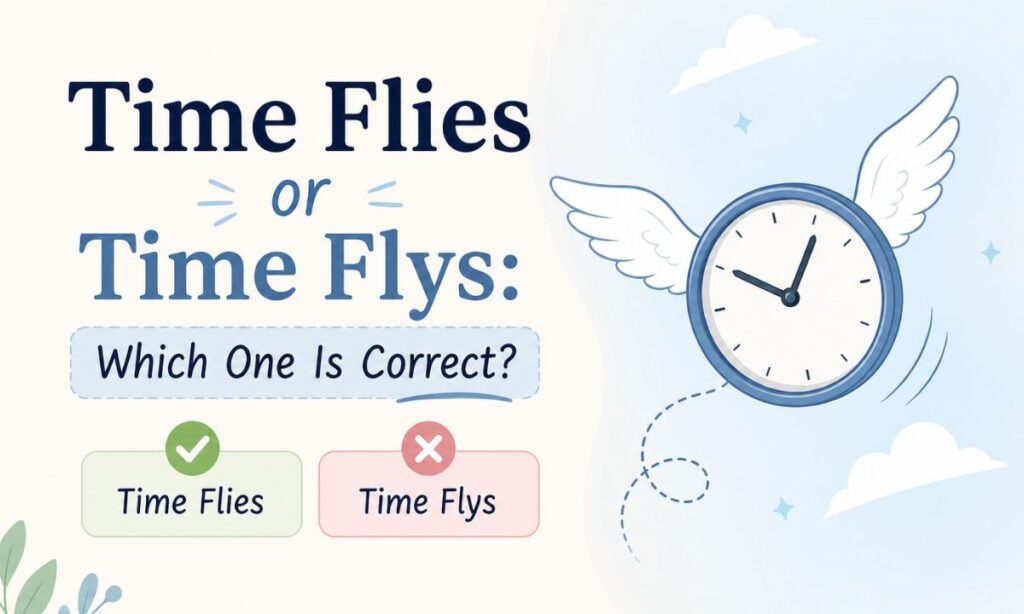
Time moves fast. One minute you’re starting a new job, and the next, ten years have gone by. People often reach for a phrase to describe that feeling, and that’s where the confusion starts. Is it time flies or time flys? This mix-up trips up students, writers, and even native English speakers. Most people know the phrase by ear, but hesitate the moment they need to type it out.
Here’s the short version: only one spelling is correct in standard English. The other one looks right but breaks a basic grammar rule. In this guide, I’ll walk you through exactly why “flies” wins, how the rule works, and how to remember it for good. By the end, the time flies or time flys question won’t confuse you again.
This isn’t just a spelling quirk. The time flies or time flys mix-up shows up in emails, birthday cards, essays, and social media captions every single day. It’s one of those common mistakes that looks harmless but can quietly undercut your writing’s credibility. Getting it right takes less than a minute to learn, and once it clicks, it sticks for good.
My Quick Answer
“Time flies” is correct. “Time flys” is not a real word in standard English.
The verb “fly” changes to “flies” when used with “time” (a singular, third-person subject), just like “cry” becomes “cries” and “try” becomes “tries.” So whenever you’re debating time flies or time flys, remember: flies is the one dictionaries recognize.
Why I Found It’s “Time Flies”
When I first looked into the time flies or time flys debate, I expected a complicated answer. It turned out to be simple. English has a spelling rule for verbs ending in a consonant followed by “y.” “Fly” ends in “y,” and the letter right before it is “l,” a consonant. Following standard rules, that “y” flips to “i” and gets an “es” added when the verb is used in third-person singular form. So “fly” becomes “flies,” not “flys.”
This isn’t a random exception. It’s a pattern you’ll see across dozens of common English verbs. Once you notice it, you’ll spot it everywhere.
I also checked how major style guides and dictionaries treat this word. Merriam-Webster and Cambridge Dictionary both confirm “flies” as the standard third-person singular form. Neither lists “flys” as an alternate spelling, which settles the time flies or time flys question from an authoritative source, not just personal preference. That’s a meaningful distinction for students, editors, and ESL learners who need a reliable answer, not a guess.
The Grammar Rule I Discovered
Here’s the rule in plain terms:
- If a verb ends in a consonant + y, change the y to i and add es.
- If a verb ends in a vowel + y, just add s — no change needed.
“Fly” fits the first pattern. That’s the entire reason behind the time flies or time flys puzzle. Dictionaries like Merriam-Webster and Cambridge Dictionary both list “flies” as the correct third-person singular form of “fly.” “Flys” doesn’t appear as a standard entry.
The Consonant + Y Rule I Learned
This rule isn’t unique to “fly.” It governs a whole family of English verbs. Think about “cry,” “try,” “dry,” “study,” “carry,” and “worry.” Each one ends in a consonant followed by “y,” and each one follows the same transformation:
- cry → cries
- try → tries
- dry → dries
- study → studies
- carry → carries
- worry → worries
Apply that same logic to “fly,” and you land on “flies.” That’s why, in the time flies or time flys debate, grammar rules leave no real room for doubt.
It helps to say these words out loud. “Cries,” “tries,” “dries,” “studies,” “carries,” “worries,” and “flies” all share the same rhythm. Your ear gets used to the “-ies” ending, and that same instinct will guide you correctly the next time you’re stuck deciding between time flies or time flys.
Important Exception I Found
Not every “y” word follows this pattern. If the letter before the “y” is a vowel (a, e, i, o, u), you simply add an “s.” No spelling change needed.
Examples include:
- play → plays
- stay → stays
- enjoy → enjoys
- buy → buys
Notice the difference? “Play” has an “a” before the “y,” so it just adds an “s.” “Fly” has an “l” before the “y,” a consonant, so it needs the full change. That distinction is the entire answer to time flies or time flys.
Once you separate vowel-before-y words from consonant-before-y words, the whole English spelling system feels less random. It’s not a list of exceptions to memorize one by one. It’s a single, consistent grammar rule that just needs one quick check: what letter comes right before the “y”?
Also, read this : Shiney vs Shiny
What “Time Flies” Means
Grammar aside, “time flies” is also a well-known idiomatic expression. It doesn’t literally mean time has wings. It means time passes quickly, often without you noticing.
People use this phrase in a few common situations.
1. Expressing Surprise
You look up from your work and realize hours have disappeared. “Wow, time flies” captures that surprised feeling perfectly.
2. Reflecting on Memories
Looking back at old photos or graduation pictures often brings out this phrase. It reflects nostalgia about how quickly years have passed.
3. “Time Flies When You’re Having Fun”
This extended version is one of the most common ways people use the idiom. It suggests that enjoyable moments feel shorter than they actually are.
4. “Time Flies By”
Adding “by” doesn’t change the meaning much. It’s just a common, natural-sounding variation you’ll hear in casual conversation.
In every one of these cases, the correct phrase always uses “flies,” never “flys.” That consistency is what makes the time flies or time flys distinction so important to get right.
Beyond casual speech, the idiom also shows up often in formal writing, like graduation speeches, retirement toasts, and reflective essays. Writers reach for it because it captures a universal feeling in just two words. Whether the context is playful or sentimental, the spelling never changes. It’s always “flies,” which is one more reason the time flies or time flys question deserves a clear, confident answer.
Common Mistakes I’ve Found and How to Avoid Them

After reviewing how people misuse this phrase, a few patterns keep showing up:
- Writing “time flys” instead of “time flies.” This is the single most common error tied to the time flies or time flys confusion.
- Assuming “flys” is an informal but acceptable spelling. It isn’t recognized in standard English dictionaries.
- Confusing it with “Frisbees,” sometimes casually called “flys” in sports slang. That’s a completely different, non-standard usage and shouldn’t be applied to the idiom.
- Skipping the apostrophe in “you’re” within “time flies when you’re having fun.” Some writers mistakenly use “your” instead.
A simple fix: whenever you type this phrase, pause and picture the consonant + y rule. That mental check alone resolves the time flies or time flys question almost instantly.
Autocorrect tools usually catch “flys” and suggest “flies” automatically, but it’s still worth understanding the rule yourself. Relying only on spellcheck means you might miss the mistake in handwritten notes, quick texts, or platforms that don’t flag it. Knowing the grammar behind time flies or time flys gives you confidence no matter where you’re writing.
Real-World Examples I’ve Collected
Seeing the phrase used in real contexts helps cement the correct spelling. Here are a few examples pulled from everyday writing.
Example 1: Social Media Post
“Can’t believe my daughter turns five tomorrow. Time flies!”
Example 2: Birthday Card
“Another year older, another year wiser. Time really does fly.”
Example 3: Work Email
“It’s hard to believe we launched this project a year ago. Time flies when you’re building something great.”
Example 4: Conversation
“Wait, it’s already 6 p.m.? Time flies when you’re busy.”
Notice that in every real example above, “flies” is the standard choice. None of these use “flys,” which reinforces just how settled the time flies or time flys question really is among fluent English speakers.
Time Flies vs Time Flys: My Summary Table
| Feature | Time Flies | Time Flys |
| Grammatically correct? | Yes | No |
| Found in dictionaries? | Yes (Merriam-Webster, Cambridge) | No |
| Follows consonant + y rule? | Yes | No |
| Common in published writing? | Yes | No |
| Used in idiomatic expressions? | Yes | No |
| Recommended for formal writing? | Yes | No |
This table makes the time flies or time flys comparison easy to scan at a glance. “Flies” checks every box; “flys” checks none.
If you’re ever proofreading a document and spot “flys,” treat it the same way you’d treat any other typo. Fix it to “flies” and move on. There’s no context, formal or informal, where “flys” becomes the standard English choice over “flies.”
Other Common Variations I Found
Once you’re confident with time flies or time flys, it’s worth learning the related phrases people use just as often. Beyond “time flies,” you’ll see a few natural variations of the phrase in everyday English:
- “How time flies!”
- “Time sure flies.”
- “Doesn’t time fly?”
- “Time flies so fast these days.”
Each version keeps the same core spelling rule intact. Whether the sentence is a question, exclamation, or casual comment, the underlying grammar behind time flies or time flys doesn’t change.
Key Pattern I Noticed
Whenever “fly” pairs with a singular subject like “time,” “she,” “he,” or “it,” it becomes “flies.” Only with plural subjects (“birds fly,” “planes fly”) does “fly” stay unchanged. This subject-verb agreement rule is the real engine behind the whole time flies or time flys debate.
This is a useful shortcut for ESL learners especially. Instead of memorizing “time flies” as one fixed chunk of vocabulary, understanding the subject-verb agreement rule behind it means you can apply the same logic to new sentences confidently, without needing to look up every single one.
Memory Tips I Use to Remember the Rule
If the grammar explanation still feels abstract, these memory tricks make it stick.
Memory Trick #1: The “Baby” Method
Think of words like “baby” and “babies.” The “y” changes to “ies” in the plural form, just like “fly” becomes “flies.” If you already spell “babies” correctly, you already know how to handle “flies.”
Memory Trick #2: The French Fry Test
“Fry” becomes “fries,” just like French fries. Picture a plate of French fries next time you’re unsure about time flies or time flys, and the correct spelling should click into place.
Memory Trick #3: The Real Flies
Picture actual flying insects. Their plural is “flies,” not “flys.” That same “flies” spelling carries over to the verb form used in “time flies.”
Other Words That Follow the Same Rule
This rule applies well beyond “fly.” Common verbs and nouns that follow the same consonant + y pattern include:
- city → cities
- baby → babies
- puppy → puppies
- story → stories
- reply → replies
- deny → denies
Recognizing this shared pattern makes the time flies or time flys rule feel less like a one-off fact and more like part of a bigger system you already understand.
Pro Tip I Learned
Whenever you’re unsure whether a word needs “ies” or just “s,” check the letter right before the final “y.” Consonant means change it to “ies.” Vowel means just add “s.” This single check resolves not just time flies or time flys, but dozens of similar English spelling questions.
Keep this rule in your back pocket for essays, emails, and everyday conversation. The next time someone asks you time flies or time flys, you’ll be able to explain the answer in one sentence, backed by a real grammar rule instead of a guess.
Explore More Grammar Guides
If this cleared things up, you might also want to check out our guide on the past tense of ride: ridden or rode, our roundup of common English spelling mistakes to avoid, or our deeper breakdown of the consonant plus y spelling rule explained. Each one tackles a different everyday grammar mix-up in the same simple style.
Conclusion
The time flies or time flys debate really comes down to one simple spelling rule. Because “fly” ends in a consonant plus “y,” it changes to “flies” in its third-person singular form, matching how “cry” becomes “cries” and “try” becomes “tries.” Every major dictionary, every real-world example, and every grammar authority agrees: “time flies” is the only correct choice.
Next time you catch yourself typing this phrase, picture French fries, real flying insects, or the word “babies,” and let that memory trick guide you.
You now have the grammar rule, the memory tricks, and real examples to back up your choice. So whether you’re writing a birthday card, a work email, or a casual text, you already know how to settle time flies or time flys with total confidence. Now you’ll never mix them up again.