
My Quick Answer
“Vendor” is correct. “Vender” is an old, rarely used spelling. If you’re wondering whether it’s Vender or Vendor for your resume, website, or contract, always pick “vendor.” That’s the modern, standard choice in both American and British English.
Why I Found “Vendor” Is the Only Correct Spelling
I dug through dictionaries, style guides, and business writing samples to settle the Vender or Vendor debate once and for all. Every major dictionary — Merriam-Webster, Cambridge, and Oxford — lists “vendor” as the standard entry. “Vender” shows up only as a rare historical variant.
This isn’t a regional thing either. It’s not British English versus American English. Both sides of the Atlantic agree: “vendor” wins.
The Simple Rule I Use
Here’s the trick I rely on: think of the word “vending” machine. It has an “o,” not an “e.” Since “vendor” comes from the same root as “vend” and “vending,” the “o” spelling stays consistent. That one memory hook has saved me from typos more times than I can count.
My Definition and Meaning Analysis

Before going further into the Vender or Vendor comparison, let’s nail down what the word actually means.
What Is a Vendor?
A vendor is a person or company that sells goods or services. The vendor meaning is simple: someone on the selling side of a transaction. If you buy coffee from a cart, that person is a vendor. If your company buys software from another business, that business is a vendor too.
Common Types of Vendors
Vendors show up everywhere in daily life and business. A few examples:
- Street vendor – sells food or goods on a sidewalk or public space
- Software vendor – supplies software licenses or tools to businesses
- Wedding vendor – provides services like catering, photography, or flowers
- Market vendor – sells produce or handmade goods at a local market
Each of these uses the same correct spelling. No exceptions.
The Complete Comparison: Vendor vs Vender
So where does “vender” come from, and why do people still type it? The answer lies in history, not correctness.
The New Yorker Exception
If you’ve read The New Yorker, you may have spotted unusual spellings like “employe” or “vender” in older issues. The magazine famously used its own house style for decades, favoring some older or shortened spellings.
Vender or Vendor: The New Yorker Angle
The New Yorker vender spelling wasn’t a mistake — it was an editorial choice tied to a specific style guide. That doesn’t make “vender” correct for everyday writing. It’s a stylistic quirk, not a spelling rule you should follow in business or academic writing.
Common Myths I Discovered
While researching Vender or Vendor questions, I found a few myths worth clearing up.
Myth #1: “Vender Is the British Spelling”
Not true. British English also uses “vendor.” There’s no vendor-vs-vender split between American and British English, unlike words such as “color” and “colour.”
Myth #2: “Both Spellings Are Acceptable”
Not in modern, professional writing. Dictionaries treat “vender” as outdated or obsolete. If accuracy matters — like in contracts, resumes, or website copy — stick with “vendor.”
Myth #3: “It Doesn’t Matter Which One You Use”
It does matter, especially in business writing. Using “vender” instead of “vendor” can look like a spelling mistake to readers, editors, or clients. First impressions count, and a wrong spelling is an easy way to lose credibility.
Also, read this: Thier or Their
Vender or Vendor: Real Examples
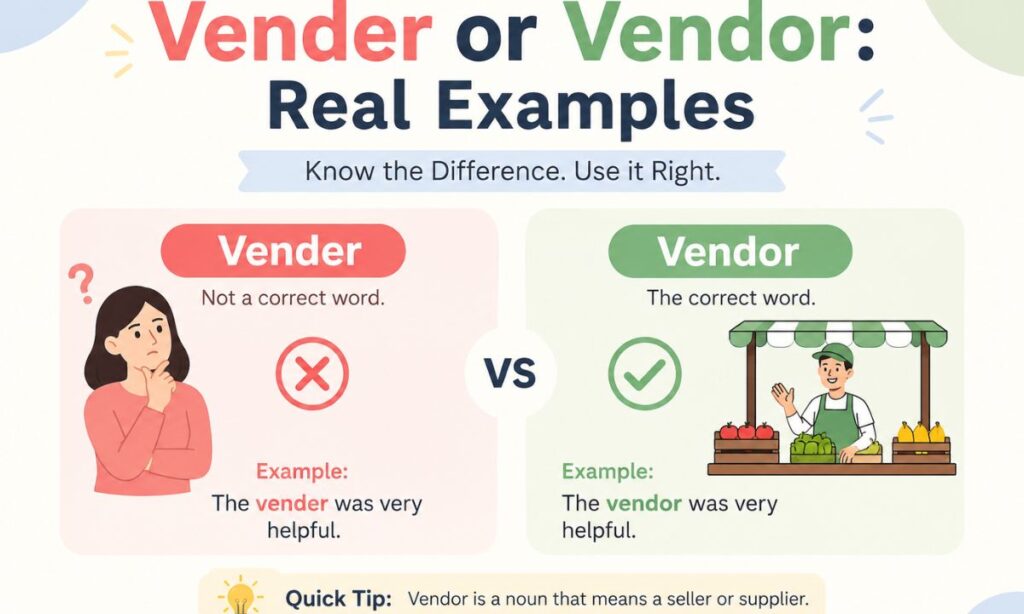
Seeing the word in context makes the Vender or Vendor rule easier to remember.
Real-World Examples I Found
Business Context
“Please confirm the vendor’s invoice before Friday.” Here, “vendor” refers to the supplier a company is paying for goods or services.
Everyday Context
“The vendor at the farmers market sold fresh strawberries.” This shows the word in a casual, everyday setting.
Event Context
“We hired three vendors for the wedding: a caterer, a florist, and a DJ.” Wedding vendor lists almost always use the correct “vendor” spelling.
Tech Context
“Our IT team switched software vendors last quarter.” In tech and SaaS writing, “vendor” appears constantly, and it’s always spelled with an “o.”
My Memory Tricks to Remember
If the Vender or Vendor question keeps tripping you up, try one of these tricks.
Trick #1: The Vending Machine Connection
Think of a vending machine. It has an “o.” A vendor operates the same logic — sell goods, use an “o.”
Trick #2: “O” for Official
“Official” spelling has an “o.” So does “vendor.” A small, silly link, but it works.
Trick #3: No “E” in Error-Free Writing
Want error-free writing? Avoid the “e” spelling. Use “vendor,” not “vender.”
Trick #4: The Sell-O Connection
A vendor sells. “Sell” and “vendor” both carry that “o” energy in spirit, even if not literally. It’s a small mental shortcut that sticks.
Vendor vs Vender: My Summary Table
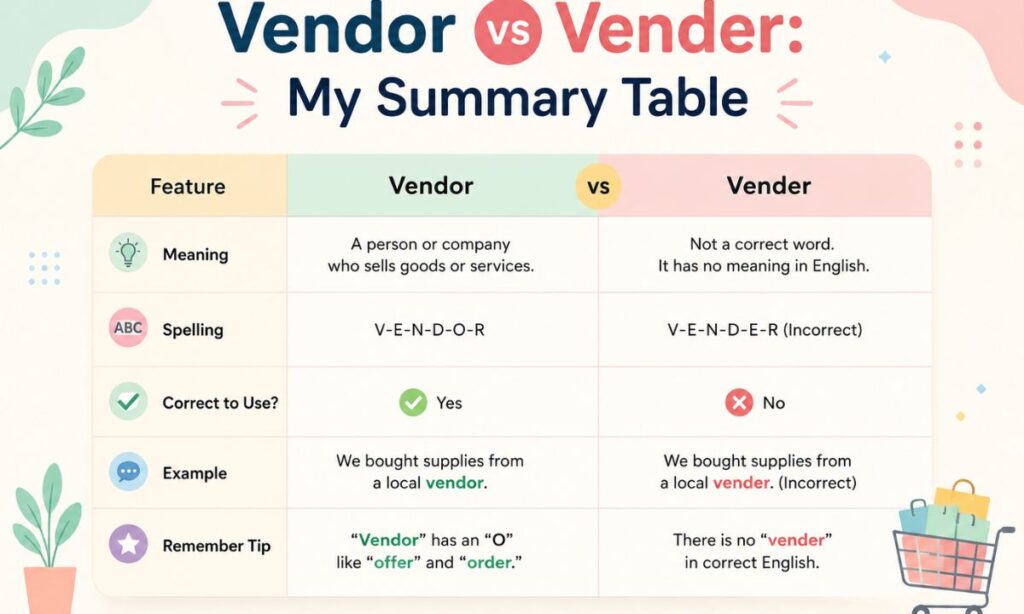
| Feature | Vendor (Correct) | Vender (Incorrect/Obsolete) |
| Standard spelling | Yes | No |
| Found in modern dictionaries | Yes | Rarely, as a variant |
| Used in American English | Yes | No |
| Used in British English | Yes | No |
| Appears in business writing | Yes | No |
| Historical use | Common in older texts | Occasional, mostly The New Yorker |
| Recommended for professional use | Yes | No |
Related Words I Explored
A few related terms often come up alongside the Vender or Vendor topic:
- Vend – the verb meaning “to sell”
- Vending – the act of selling, usually through machines
- Vendee – the buyer in a transaction (opposite of vendor)
Understanding vendor and vendee together helps clarify contracts and legal documents, where both terms often appear side by side.
Quick Test I Created
Try this short quiz to check what you’ve learned:
- Which is correct: “software vender” or “software vendor”?
- Is “vender” a real word in modern English?
- Does British English use “vender” instead of “vendor”?
Answers: vendor; technically yes, but obsolete; no.
Explore More Grammar Guides
If you enjoyed clearing up the Vender or Vendor confusion, check out our other grammar guides on commonly confused word pairs, like affect vs effect and its vs it’s, for more quick, confident answers.
Conclusion
The Vender or Vendor debate has a clear winner: “vendor” is the correct, modern spelling in both American and British English, while “vender” is an outdated variant you’ll rarely see outside old texts or The New Yorker’s house style. Whether you’re writing a business contract, a wedding vendor list, or a quick email, choosing “vendor” keeps your writing accurate and professional.
Remember the vending machine trick, keep that “o,” and you’ll never second-guess the Vender or Vendor question again. Bookmark this guide, share it with a colleague who still types “vender,” and write with confidence from here on out.