
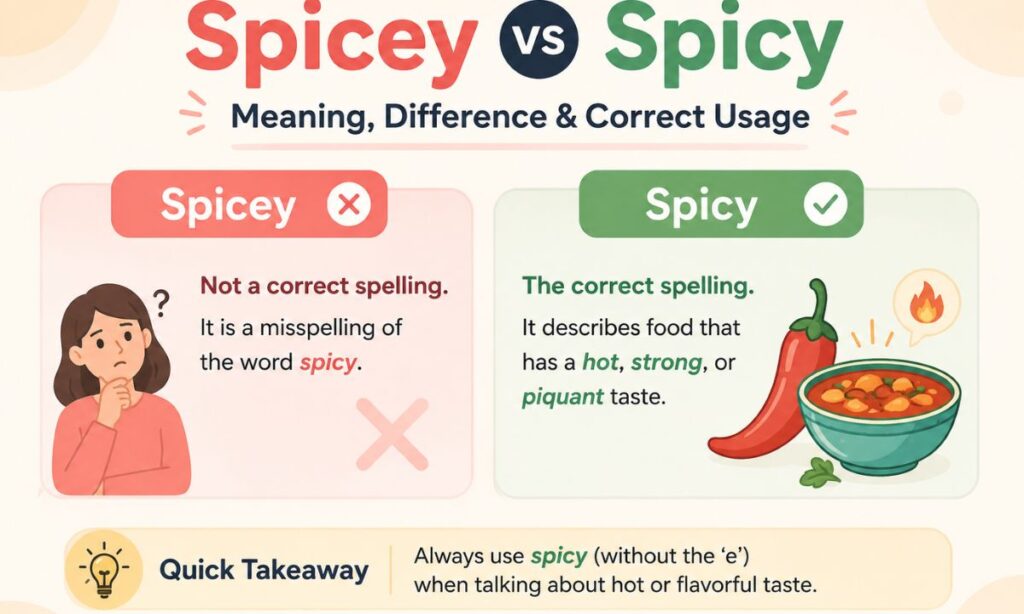
Do you write “spicey” or “spicy”? Most people pause here. It’s a small word. But it trips up a lot of writers. The good news is that the answer is simple, and once you know it, you’ll never second-guess yourself again.
This guide breaks down Spicey vs Spicy in plain English. We’ll cover the spelling rule behind it, what the word actually means, how to use it in real sentences, and the mistakes people make most often. By the end, Spicey vs Spicy won’t feel like a puzzle anymore — it’ll just be something you know.
My Quick Answer
“Spicy” is the correct spelling. “Spicey” is a common misspelling that isn’t recognized by standard dictionaries like Merriam-Webster or Cambridge Dictionary. When you’re debating Spicey vs Spicy, always go with “spicy” — in food writing, casual chat, or formal documents.
Why I Found It’s Spelled “Spicy”
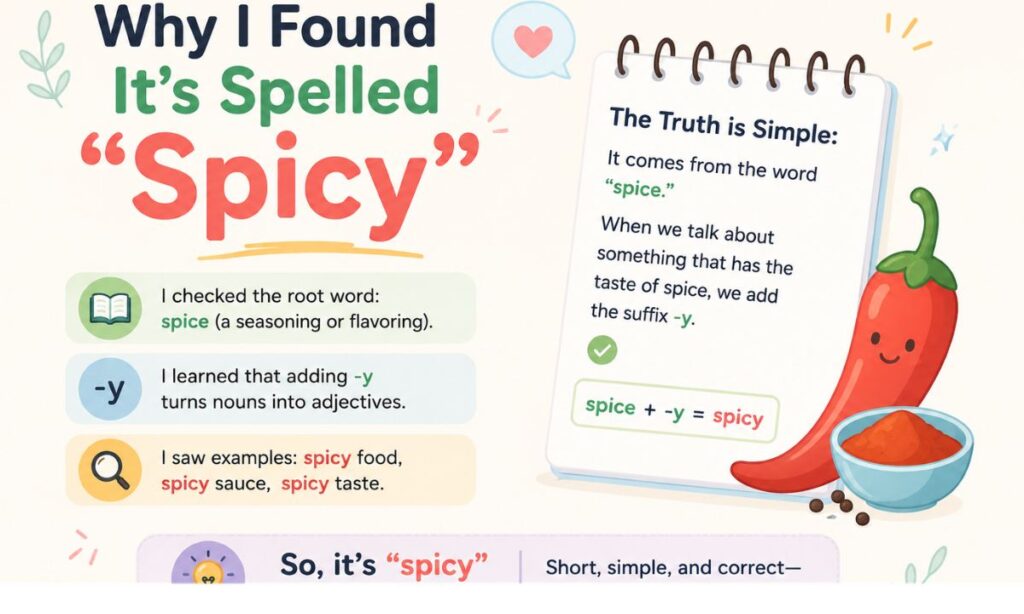
English has a habit of bending letters to fit patterns, and “spicy” is a textbook example. The base noun is “spice.” To turn a noun into an adjective, English often adds the suffix “-y.” But there’s a catch: when a word ends in a silent “e,” that “e” usually drops before “-y” is added.
That’s the whole story behind Spicey vs Spicy. “Spice” loses its silent “e,” and “-y” takes its place, giving you “spicy.” Add the “e” back in, and you get “spicey” — a version that looks plausible but isn’t standard English.
The “Drop the E and Add Y” Rule I Follow
This isn’t a random quirk. It’s a recognized spelling pattern:
- Word ends in a silent “e”
- Drop the “e”
- Add the suffix “-y”
Think of “ice” becoming “icy,” or “grace” becoming “gracy” in dialect but not standard form. The cleanest parallel is “spice” to “spicy.” Once you see the pattern, Spicey vs Spicy stops being confusing — it’s just this rule applied consistently.
My Definition and Meaning Analysis
“Spicy” carries more than one meaning, and understanding all of them helps settle Spicey vs Spicy debates for good.
1. Food with Heat
The most common use: food that has a noticeable heat level, usually from chili peppers, pepper, or hot spices. A vindaloo curry, hot wings, or a jalapeño salsa all qualify as spicy.
2. Flavorful and Seasoned
“Spicy” can also describe food that’s richly seasoned, even without heat. A dish packed with cinnamon, cloves, or cardamom might be called spicy for its bold, layered flavor.
3. Exciting or Lively
Beyond food, “spicy” describes anything energetic or bold — a spicy dance performance, a spicy debate, or a spicy plot twist in a novel.
4. Slightly Scandalous
Informally, “spicy” hints at something a little risqué or gossip-worthy — a spicy rumor, a spicy comment, or spicy office drama.
Spicey vs Spicy Examples
Seeing the words side by side in real sentences makes the difference obvious.
- Correct: “This curry is incredibly spicy.”
- Incorrect: “This curry is incredibly spicey.”
- Correct: “She gave a spicy response during the interview.”
- Incorrect: “She gave a spicey response during the interview.”
Every time, “spicy” is the version that passes a dictionary check.
The Pattern: Similar Word Transformations
“Spice” to “spicy” isn’t a one-off. English does this constantly:
| Noun | Adjective |
| Ice | Icy |
| Juice | Juicy |
| Grease | Greasy |
| Space | Spacy (spacey is common informally) |
| Nose | Nosy |
Why This Pattern Makes Sense
Dropping the silent “e” keeps spelling efficient and consistent. It also keeps pronunciation smooth — adding “-ey” instead can make a word look like it needs an extra syllable, which isn’t how “spicy” sounds. This is another reason the Spicey vs Spicy debate favors “spicy” every time.
Spicy vs Spicey: My Visual Comparison
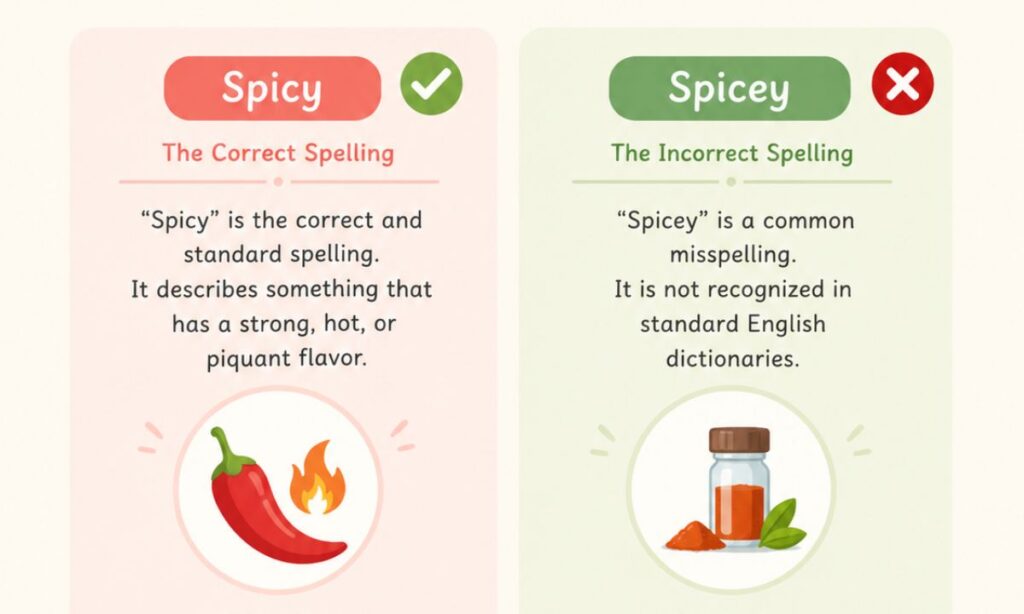
Picture two labels on a hot sauce bottle. One says “Extra Spicy.” The other says “Extra Spicey.” The first looks professional and edited. The second looks like a typo slipped past proofreading. That visual gut-check is often the fastest way to settle Spicey vs Spicy in your head.
Real-World Examples I Use
Culinary and Food Examples:
- “The chef added extra chili to make the sauce spicier.”
- “This is the spiciest ramen on the menu.”
Informal and Creative Examples:
- “Their group chat got spicy after the game.”
- “That’s a spicy hot take.”
Professional and Descriptive Examples:
- “The report includes a few spicy statistics on market competition.”
- “Her feedback was spicy but fair.”
Examples of What NOT to Write:
- “The wings are spicey.” ❌
- “That’s a spicey topic for the meeting.” ❌
Spicey vs Spicy Synonyms
If you want variety in your writing, “spicy” has plenty of company: piquant, zesty, peppery, pungent, fiery, hot, seasoned, flavorful. None of these carry the Spicey vs Spicy spelling problem, but they’re useful when you want to avoid repeating “spicy” too often.
Read more! Vender or Vendor
Pronunciation Guide I Use
Phonetic Pronunciation
“Spicy” is pronounced /ˈspaɪ.si/ — two syllables, stress on the first. It rhymes with “icy” and “dicey.” There’s no version of the word that naturally stretches to three syllables, which is another subtle clue in the Spicey vs Spicy comparison: “spicey” visually suggests an extra beat that doesn’t belong.
Spicy vs Spicey: My Summary Table
| Feature | Spicy | Spicey |
| Dictionary status | Standard, correct | Not recognized |
| Formal writing | Yes | No |
| Casual writing | Yes | Avoid |
| Follows spelling rule | Yes (drop e, add y) | No |
| Recommended use | Always | Never |
Did You Know?
Merriam-Webster and Cambridge Dictionary both list only “spicy” as the standard adjective form of “spice.” “Spicey” doesn’t appear as an alternate spelling in either source, which settles the Spicey vs Spicy question from an authoritative standpoint.
Common Mistakes I’ve Learned to Avoid

Mistake #1: Adding Unnecessary Letters
The biggest issue in the Spicey vs Spicy debate is simply adding a letter that doesn’t belong. Autocorrect sometimes lets it slide, but dictionaries don’t.
Mistake #2: Confusing with Similar Words
Words like “spacey” (meaning distracted or dreamy) are informally accepted with an “e.” This can trick writers into assuming “spicey” follows the same pattern. It doesn’t.
Mistake #3: Inconsistent Spelling
Switching between “spicy” and “spicey” within the same document looks careless. Pick “spicy” and stay consistent throughout.
When to Use “Spicy” in Different Contexts
Food Writing
Menus, recipes, and food blogs should always use “spicy” — it’s the professional standard.
Casual Conversation
Texting a friend? “Spicy” still works fine and reads as correct, not stiff.
Professional Writing
Reports, emails, and articles should stick to “spicy” to maintain credibility.
Creative Writing
Even in dialogue or stylized prose, “spicy” is the safer, recognized choice unless you’re intentionally writing a character’s typo.
Synonyms and Related Terms I Found
Beyond the direct synonyms mentioned earlier, related vocabulary includes heat level, peppery, seasoned, zesty, fiery, and piquant. These terms help you avoid repetition while keeping the Spicey vs Spicy standard spelling intact.
Cultural Context and Spiciness Levels
Understanding Spiciness Levels:
Spiciness is often measured using the Scoville scale, which rates the heat of chili peppers. A bell pepper sits near zero, while a ghost pepper can rank in the hundreds of thousands.
Cultural Differences:
What counts as “spicy” varies by region. A dish considered mild in parts of South Asia might be labeled extremely spicy elsewhere. This cultural variation doesn’t change the Spicey vs Spicy spelling rule — it only affects how the word “spicy” is applied to taste.
Pro Tip I Learned
When unsure about any spelling, checking a trusted dictionary settles it in seconds. For Spicey vs Spicy, that check consistently confirms “spicy” as correct.
Explore More Grammar Guides
Curious about other tricky word pairs? Check out our guides on Affect vs Effect, Its vs It’s, and Compliment vs Complement for more clarity on common English mix-ups.
Conclusion
The Spicey vs Spicy question comes down to one simple rule: drop the silent “e” in “spice,” then add “-y.” That gives you “spicy” — the only spelling recognized by major dictionaries and the only one that belongs in food writing, professional documents, or everyday conversation. “Spicey” might look tempting, especially if you’re thinking of words like “spacey,” but it doesn’t hold up against standard English spelling.
Now that you know the rule, the reasoning behind it, and how to use “spicy” correctly across different contexts, you’re set. Bookmark this guide if you ever second-guess yourself again — but chances are, you won’t need to. Spicey vs Spicy is settled, and you’ll never mix them up again.