
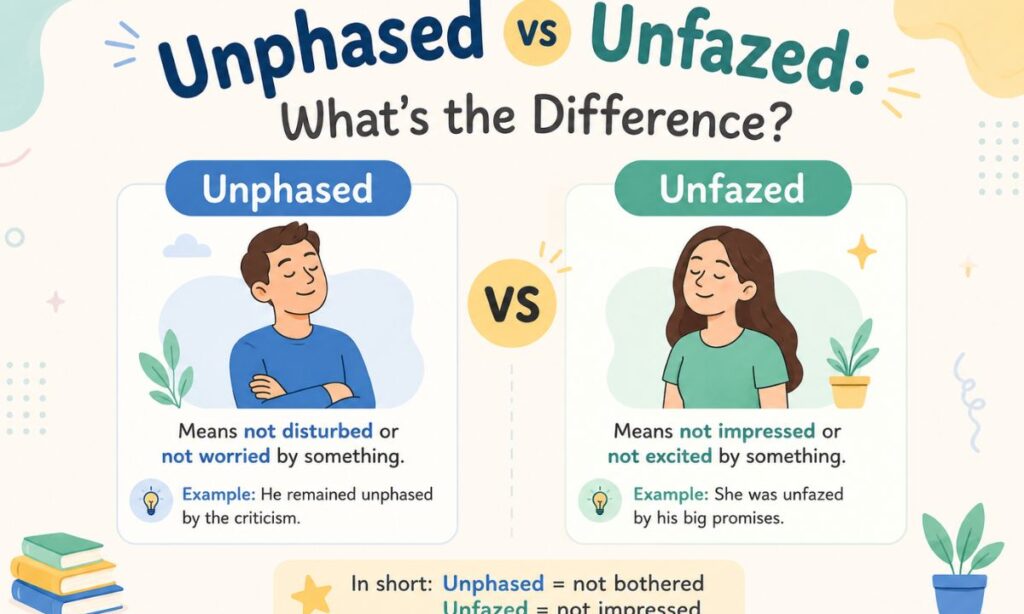
You saw the word. Something looked off. Was it “unphased” or “unfazed”? Most people pause right here. It’s a small mix-up. But it shows up everywhere — texts, emails, even news articles.
Here’s the short version: unfazed is the correct word. Unphased is a common misspelling, born from confusing “faze” with “phase.” This guide breaks down the unphased vs unfazed debate in plain English, so you can write with confidence every single time.
My Quick Answer
If someone stayed calm under pressure, they were unfazed — not unphased. Save “phase” for stages or steps, like a “phase of the moon” or “phase two of a project.” When it comes to unphased vs unfazed, only one is a real, dictionary-approved word: unfazed.
Why I Found That “Unfazed” Is Correct
When I dug into dictionaries and style guides, the pattern was clear. “Unfazed” comes from the verb “faze,” which means to disturb or unsettle someone. Add the prefix “un-” and you get “unfazed” — not disturbed, not shaken.
“Unphased,” on the other hand, isn’t a standard dictionary entry. It looks like it should mean something similar because it sounds identical when spoken aloud. But spelling matters in writing, and this is where the unphased vs unfazed confusion causes real problems for students and professionals alike.
The Core Difference I Found
The difference boils down to word origin. “Faze” means to disturb or worry. “Phase” means a stage or period of time. They sound the same, but they come from completely different roots. That’s the entire unphased vs unfazed puzzle in one sentence.
What does “Unfazed” mean?
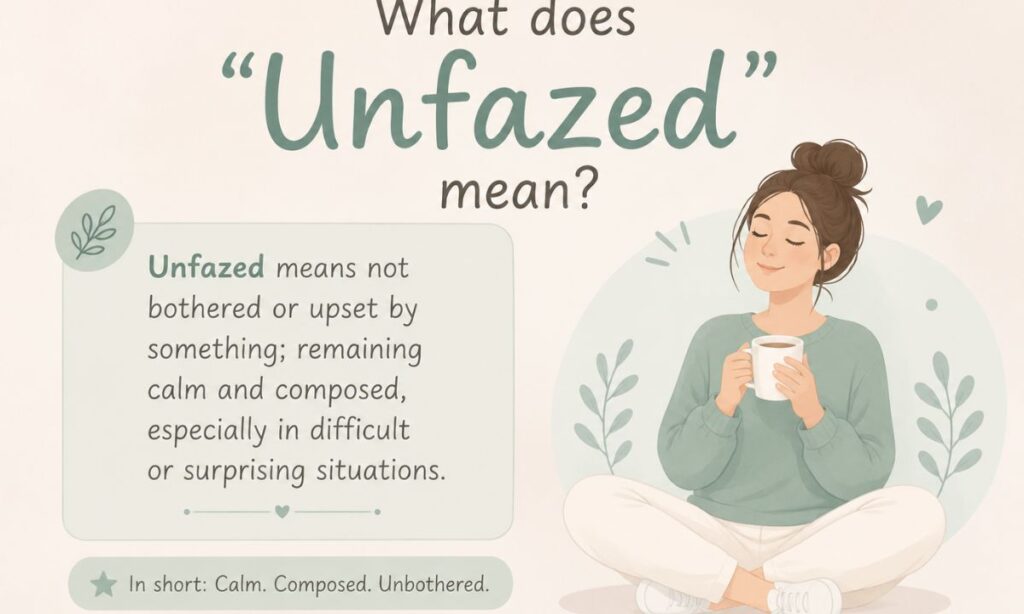
“Unfazed” describes someone who isn’t bothered, worried, or thrown off by a situation. Think of a pilot landing a plane during turbulence without a flicker of panic. That pilot is unfazed.
It’s an adjective, and it typically follows a linking verb: “She remained unfazed,” or “He looked unfazed by the criticism.” Every time you’re tempted to write “unphased” here, remember the unphased vs unfazed rule — the correct choice is always “unfazed.”
My Definition and Usage Analysis
Let’s look at how “unfazed” actually functions in real sentences, broken down by common scenarios.
1. Remaining Calm Under Pressure
This is the most common usage. A surgeon during a complication, a parent during a toddler meltdown, a pilot during turbulence — all can be described as unfazed.
2. Unaffected by Criticism
When someone hears harsh feedback and doesn’t flinch, they’re unfazed. This usage shows up constantly in interviews and profiles of public figures.
3. Steady in a Crisis
Emergency responders, firefighters, and ER doctors are often praised as unfazed professionals — steady hands in chaotic moments.
4. Unimpressed or Undeterred
Sometimes “unfazed” leans slightly different — someone isn’t impressed or intimidated by a challenge, and they push forward anyway.
My Complete Comparison Table: Unfazed vs Unphased
| Feature | Unfazed | Unphased |
| Dictionary status | Standard, correct word | Not a standard entry |
| Root word | Faze (to disturb) | Phase (a stage) |
| Meaning | Calm, unbothered | No accepted meaning |
| Usage in formal writing | Recommended | Avoid |
| Common in casual texting | Occasionally seen (incorrect) | Frequently misused here |
| Editor’s verdict | Always correct | Always a typo |
This table sums up the unphased vs unfazed debate at a glance — one column is the rule, the other is the mistake.
Real Examples I Found in Daily Life
Seeing correct and incorrect examples side by side makes the unphased vs unfazed rule stick faster than any explanation.
✓ Correct Examples I Use:
- She stayed unfazed during the entire negotiation.
- The goalkeeper looked unfazed after the missed penalty.
- Nothing seems to leave him unfazed — not even deadlines.
✗ Incorrect Examples I Avoid:
- She stayed unphased during the entire negotiation.
- The goalkeeper looked unphased after the missed penalty.
- Nothing seems to leave him unphased — not even deadlines.
Swap “unphased” for “unfazed” in every one of those, and the sentence becomes correct instantly.
Unfazed or unphased UK
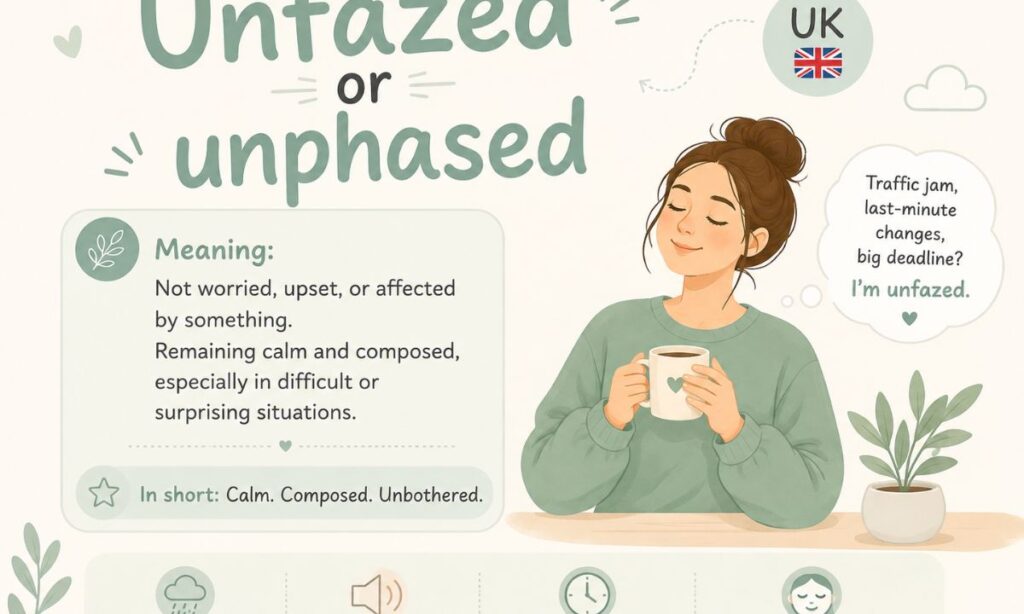
British English follows the same rule as American English here — “unfazed” is correct on both sides of the Atlantic. Neither Oxford nor Cambridge lists “unphased” as an accepted variant. So if you’ve been wondering whether British publications treat unphased vs unfazed differently, they don’t. The spelling rule stays consistent worldwide.
Also, read this: Spicey vs Spicy
My Memory Tricks to Remember
Grammar rules stick better with a hook. Here are four tricks that solve the unphased vs unfazed mix-up for good.
Trick #1: The “Z” for “Zero Disturbance”
“Unfazed” has a Z, and Z stands for “zero” disturbance. If nothing shook them, it’s spelled with a Z.
Trick #2: The “Phase” Connection
“Phase” relates to time and stages — moon phases, project phases. If your sentence has nothing to do with a stage or step, don’t reach for “phase.”
Trick #3: The Meaning Test
Ask yourself: am I describing someone’s calm reaction? If yes, you need “unfazed.” If you’re describing a stage of a process, you might actually need “phase” — just not “unphased.”
Trick #4: The “Faze” Word Family
Remember that “faze” is a small, standalone verb meaning “to disturb.” Its whole family — faze, fazed, unfazed — keeps the Z. None of them borrow letters from “phase.”
The “Faze” vs “Phase” Confusion: My Deep Dive
Most people who write “unphased” aren’t careless. They’re victims of a sneaky feature of English: two words that sound exactly alike but mean completely different things.
Why These Two Words Get Mixed Up
English is full of homophones, and “faze” and “phase” are a textbook example. Once you understand why they’re confused, the unphased vs unfazed error becomes much easier to catch before you hit publish.
1. Identical Pronunciation
Both words are pronounced “fayz.” There’s no audio clue to tell you which spelling is correct — you have to know the meaning.
2. “Phase” Is More Common
“Phase” appears far more often in everyday writing — school phases, moon phases, project phases. That familiarity makes people default to it, even when “faze” is what’s needed.
3. “Faze” Is Less Familiar
“Faze” rarely appears outside the word “unfazed.” Because it’s less common on its own, writers forget it exists and reach for the more familiar “phase” instead.
4. Sound-Alike Pattern
This kind of mix-up isn’t rare in English. Homophone pairs like “affect/effect” and “your/you’re” trip up writers the same way the unphased vs unfazed pair does.
My Research on “Faze” – The Root Word
“Faze” is a verb meaning to disturb, worry, or unsettle someone. It’s often used in the negative: “Nothing fazes her.” Add “un-” and “-ed,” and you land on “unfazed” — the calm, collected version of that verb.
Difference Between Unphased vs Unfazed
To summarize the core distinction one more time: “unfazed” is a real adjective describing calmness. “Unphased” is not recognized by major dictionaries and should be treated as a spelling error whenever it appears in formal or professional writing.
Similar Sound-Alike Confusions I Found
The unphased vs unfazed mix-up has plenty of company in English. A few similar pairs worth knowing:
- Affect vs. Effect
- Compliment vs. Complement
- Discreet vs. Discrete
- Stationary vs. Stationery
Learning one homophone rule often makes the next one easier to spot.
Expert Opinions and Dictionary Evidence I Found
Merriam-Webster Dictionary
Merriam-Webster lists “unfazed” as a standard entry, defined around the idea of not being disturbed or embarrassed by something.
Oxford English Dictionary
Oxford follows the same pattern, tracing “unfazed” back to the verb “faze” and offering no listing for “unphased” as a standard alternative.
Grammar Experts & Style Guides
Style guides across journalism and academic writing consistently flag “unphased” as an error, reinforcing that the unphased vs unfazed question has one clear, agreed-upon answer.
NPR Analysis
Language commentary from major outlets has pointed out this exact mix-up as one of the more common homophone errors in modern writing, especially in fast-typed content like social media posts.
Unfazed Pronunciation
“Unfazed” is pronounced “un-FAYZD” — three syllables, stress on the middle one. Saying it aloud won’t help you spell it correctly, since it sounds identical to the incorrect “unphased.” That’s exactly why the unphased vs unfazed rule has to be memorized rather than sounded out.
Common Contexts Where I Use “Unfazed”

Professional Settings
Job interviews, high-stakes meetings, and public speaking are classic settings where someone might remain unfazed under scrutiny.
Emergency Situations
First responders and medical teams are often described as unfazed while managing crises calmly.
Sports & Performance
Athletes under pressure — free throws, penalty kicks, final serves — are frequently called unfazed by commentators.
Personal Resilience
Someone who bounces back from setbacks without losing composure is often praised as unfazed by hardship.
Criticism & Feedback
Writers, artists, and public figures who take harsh reviews in stride are commonly described as unfazed critics of their own work.
Unexpected Challenges
Sudden schedule changes, technical failures, last-minute surprises — staying unfazed through these moments is a mark of steady composure.
My Personal Tips for Avoiding This Mistake
Run a quick mental check before you hit send: does the sentence describe calmness or disturbance? If yes, it’s “unfazed.” Does the sentence involve a stage, step, or period of time? Then “phase” might belong somewhere else in your writing — but never as “unphased.”
My Final Warning
Spell-check won’t always catch this one, since “unphased” can slip past some tools as a plausible-looking word. Proofread manually whenever the unphased vs unfazed question comes up in your writing.
Explore More Grammar Guides
If this cleared things up, you might also enjoy guides on affect vs. effect, commonly confused English words, and silent letters in English spelling — all covering the same kind of everyday mix-up.
Conclusion
The unphased vs unfazed debate has a simple resolution: “unfazed” is correct, and “unphased” is a spelling mistake — no matter how often it shows up online. Remember the Z, remember “faze” means to disturb, and keep “phase” for stages and steps. That one rule solves the entire mix-up.
Next time you’re describing someone who stayed calm, cool, and collected, you’ll know exactly which word to reach for. Now you’ll never mix them up again.